
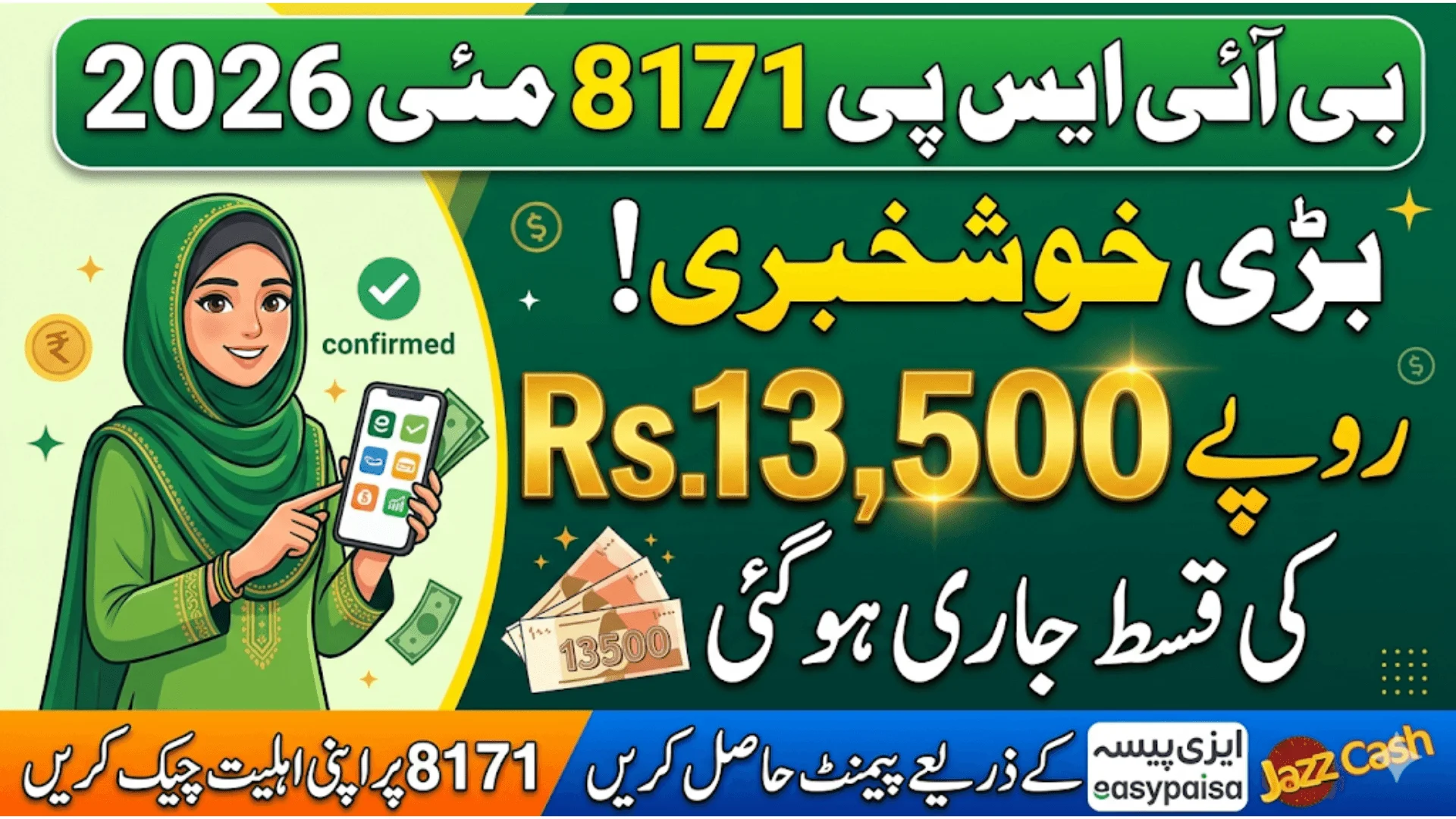
BISP 8171 May 2026 Payment Update
BISP 8171 May 2026 Payment: Millions of Pakistani families registered under the Benazir Income Support Program have been waiting for a payment update, and the wait is finally over. The Rs. 13,500 Kafalat installment for May 2026 is now actively being distributed, and this time the process has changed in a way that directly benefits women living in rural areas and small towns. For years, collecting BISP funds meant one thing a long journey to a crowded campsite, hours of standing in lines, and the constant risk of biometric failure or agent fraud. That picture is shifting in 2026.

The program has expanded its digital disbursement network through Easypaisa and JazzCash retailers, bringing payment access closer to where beneficiaries actually live. If you or someone in your family is a registered Kafalat beneficiary, this guide covers exactly what has changed, how to collect the new payment, and what mistakes to avoid during the process.
Also Read: BISP 8171 Web Portal Rs. 14,500 Payment Confirmed For May 2026
Table Quick Information
| Detail | Information |
| Programme Name | Benazir Kafalat Programme (BISP) |
| Payment Amount | Rs. 13,500 per eligible household |
| Payment Month | May 2026 |
| Payment Channels | JazzCash & Easypaisa Retailers |
| Verification Method | Biometric (Fingerprint) via CNIC |
| SMS Helpline | 8171 |
| Eligibility Check | Send CNIC number to 8171 |
Why BISP Shifted to Digital Payment Partners in 2026
The older camp-based payment model was functional but came with serious logistical problems for low-income households. Women from distant villages had to arrange transport, sometimes spending Rs. 500 to Rs. 1,000 just to reach a distribution point, which ate into the benefit they were supposed to receive. In densely populated districts, the camps became overcrowded and biometric machines frequently failed under pressure.
The Benazir Income Support Program responded to these complaints by formalizing agreements with two of Pakistan’s largest mobile financial service providers: JazzCash and Easypaisa. Both networks have thousands of active retail agents spread across urban centers and semi-rural markets, making them a practical choice for last-mile payment delivery. The district-by-district rollout that began in late 2025 has accelerated significantly heading into the May 2026 disbursement cycle.
Also Read: BISP 14500 New Qist 2026 Confirmed For Families Before Eid-ul-Adha
Who Qualifies for the Rs. 13,500 BISP Kafalat Payment?
Receiving money through JazzCash or Easypaisa does not automatically mean a beneficiary qualifies. The payment system is still tied to BISP’s National Socioeconomic Registry (NSER), and only households that meet the programme’s criteria are approved for the current installment.
Eligibility is determined through the PMT (Proxy Means Test) score, which evaluates household income, assets, and living conditions. Families with a score below the defined poverty threshold remain on the active beneficiary list. Any change in household circumstances, government employment, or failure to update NADRA records can result in temporary suspension from the payment cycle.
Basic Eligibility Checklist
• Active registration under the Benazir Kafalat Programme
• Valid and unexpired CNIC belonging to the registered female beneficiary
• Successful NSER survey completion and data verification
• Low PMT score confirming the household falls below the poverty line
• No member of the household currently employed in a government position
• Biometric data on record with NADRA must be functional
Also Read: BISP 14500 Registration Status CNIC, Marriage, Children & Eligibility Rules
Step-by-Step Guide to Collecting Payment via JazzCash
JazzCash has the wider retailer presence among the two platforms and is currently the primary channel through which most BISP payments are being processed in districts where the digital system is active. The process is straightforward but requires the beneficiary to be physically present, as proxy collection is not permitted.
Beneficiaries should visit only those retailers who display official BISP payment authorization signage. Unauthorized agents have been reported in some areas, and using them risks both fraud and biometric data misuse.
Collection Steps at a JazzCash Outlet
• Step 1: Locate an authorized BISP-approved JazzCash retailer in your area
• Step 2: Carry the original CNIC of the registered female beneficiary
• Step 3: Place your fingerprint on the biometric device provided by the retailer
• Step 4: Wait for the system to confirm your payment status and amount
• Step 5: Collect the full Rs. 13,500 and request a printed payment receipt
• Step 6: Count the full amount before leaving the counter
Easypaisa BISP Payments: Availability and Process in May 2026
Easypaisa is still in an expansion phase under the BISP digital payment framework. While the network is not yet as widely deployed as JazzCash for Kafalat disbursements, it is fully operational in a growing number of districts. Beneficiaries in areas where Easypaisa retailers are BISP-authorized can follow the same biometric verification process to collect their payment.
One practical advantage of Easypaisa’s retail model is its presence in smaller markets and bazaars, which can reduce travel time for beneficiaries who previously had to cross tehsil boundaries to reach a payment point. As coverage expands through mid-2026, more families are expected to gain access to this option.
Also Read: BISP 8171 Online Registration 2026 Check Eligibility By CNIC
Required Documents for BISP Payment Collection
Missing a single document at the counter is one of the most common reasons beneficiaries return home without their payment. Preparation before visiting any retailer saves both time and the cost of repeated trips.
Documents to Carry
• Original CNIC of the registered female beneficiary (photocopies not accepted)
• Active mobile number registered in BISP records for SMS confirmation
• NSER survey slip if available, as additional proof of registration
• NADRA biometric update receipt if fingerprints were recently re-enrolled
Fraud Risks and How Beneficiaries Can Stay Protected
As digital disbursement has expanded, so has the number of people attempting to exploit beneficiaries who are unfamiliar with the new process. Reports from field offices indicate two recurring fraud patterns: fake OTP requests via phone calls claiming to be from BISP staff, and commission-charging agents who demand a cut before processing the payment.
The Benazir Income Support Programme does not charge any fee for payment processing. Any retailer or individual asking for money in exchange for ‘fast processing’ or ‘system activation’ is engaging in fraud and should be reported immediately to the BISP helpline or nearest tehsil office.
Safety Rules for Payment Collection
• Never share OTP codes received on your mobile with anyone, including retailers
• Do not pay any agent a commission or fee for processing your payment
• Only use retailers with a clearly visible BISP authorization certificate
• Verify all BISP-related SMS messages originate from the 8171 number
• Keep your payment receipt as proof of collection
• If money is deducted, report the incident to the BISP district office immediately
Also Read: Benazir Kafaalat Program Updated Rules 2026 Eligibility For 14500
What to Do If Your BISP Payment Has Not Arrived
Eligible families sometimes complete verification but still do not receive their installment due to system delays, expired CNIC records, or unresolved biometric mismatches. This is a solvable problem, but it requires taking the right steps in the correct order.
The fastest first step is to send your CNIC number to 8171 and check the response. The automated system confirms payment status, pending issues, and whether the installment has been released. If the SMS confirms eligibility but payment has not been received at the retailer, a visit to the BISP tehsil office with original documents is the next course of action.
Troubleshooting Steps
• Send CNIC to 8171 and note the response message carefully
• Visit the nearest BISP Tehsil Office with your original CNIC and NSER slip
• Request a formal payment verification from the office record
• If fingerprint mismatch is flagged, visit NADRA for biometric re-enrollment
• Call the BISP helpline and file a formal complaint for deductions or non-payment
Old Distribution System vs. New Digital Payment Model
| Challenge (Old System) | Improvement (Digital Model) |
| Long-distance travel to camps | Payments available at nearby retail outlets |
| Hours-long queues in all weather | Faster processing with fewer people per outlet |
| High transport costs for rural women | Reduced travel expenses due to local access |
| Limited payment camp schedules | Retailers available during normal market hours |
| Higher fraud risk at crowded camps | Digital tracking reduces unauthorized deductions |
Also Read: Punjab Schools Summer Vacation 2026 Schedule Announced
Why Biometric Verification Remains a Non-Negotiable Requirement
Some beneficiaries, particularly elderly women, find the fingerprint verification step difficult and occasionally frustrating. The system, however, keeps this requirement in place for strong reasons. Without biometric confirmation, the payment system would have no reliable way to confirm that the correct person is collecting the funds. In the past, unauthorized relatives and agents exploited the lack of verification to withdraw payments that were not theirs.
Biometric verification connects each payment directly to the registered CNIC holder through NADRA’s database. This creates a digital audit trail that makes it significantly harder to manipulate or duplicate payments. Women who face repeated fingerprint failures due to age or manual labor are advised to visit a NADRA office for biometric data renewal before their next scheduled payment cycle.
Common Mistakes That Delay or Block BISP Payments
Expired CNIC
An expired identity card immediately halts payment processing. BISP systems are linked to NADRA records, and any discrepancy or expiry triggers an automatic hold on the installment. Beneficiaries should renew their CNIC well before the payment disbursement period begins.
Mobile Number No Longer Active
If the phone number registered in BISP records is no longer in use or has been ported to another network, important verification alerts and OTP messages will not reach the beneficiary. Updating the mobile number through the BISP office before visiting a retailer prevents this issue.
Sending Someone Else to Collect
Payments under the Kafalat program are issued exclusively to the registered female beneficiary. Sending a male family member or another woman in place of the registered person results in collection failure and can trigger a review of the account.
Also Read: How To Get 3000 Rupees From Sindh Government Through CNIC Without Any Agent
Frequently Asked Questions
Can BISP Kafalat payment be collected without biometric verification?
No. Biometric fingerprint confirmation is mandatory for all payment releases in the current system. Exceptions are only granted after formal NADRA re-enrollment.
Does a beneficiary need a personal JazzCash or Easypaisa account to receive payment?
No personal mobile wallet is required. Payments are disbursed directly through authorized retailers using CNIC-based biometric verification.
How can I confirm whether my district has JazzCash or Easypaisa coverage for BISP?
Send your CNIC to 8171. The response message indicates payment status and which channel is active in your district.
Is Easypaisa available in all districts for BISP payment collection in May 2026?
No. Easypaisa coverage is still expanding on a district-by-district basis. JazzCash has broader availability at this time.
What happens if a retailer deducts money from my Rs. 13,500 payment?
Immediately report the incident to the BISP helpline or the nearest tehsil office with your payment receipt. Unauthorized deductions are a punishable offence under the programme’s fraud policy.
Can I check my BISP payment status before going to a retailer?
Yes. Send your CNIC number via SMS to 8171 to receive a status update before visiting any retail outlet.
What should I do if my fingerprints are not being recognized at the retailer?
Visit a NADRA office to get your biometric data updated. After re-enrollment, request a NADRA slip and carry it to the BISP tehsil office for processing.
Final Thoughts
The expansion of JazzCash and Easypaisa as BISP payment channels in May 2026 represents a meaningful step toward making financial assistance more accessible for the families who need it most. The shift reduces dependence on fixed campsites and gives registered beneficiaries more flexibility in when and where they collect their Rs. 13,500 Kafalat installment. Families who keep their CNIC current, maintain an active registered mobile number, and use only officially authorized retailers are finding the new process significantly smoother than what existed before.
The government’s plan to widen digital payment coverage across more districts through the rest of 2026 suggests that the improvement is still in progress. Watching how quickly this rollout reaches the most remote districts will be the real test of whether digital disbursement can deliver on its promise of inclusion for Pakistan’s most underserved households.
Also Read: 8171 Portal Status Check Solving SIM Eligibility And Registration Issues