
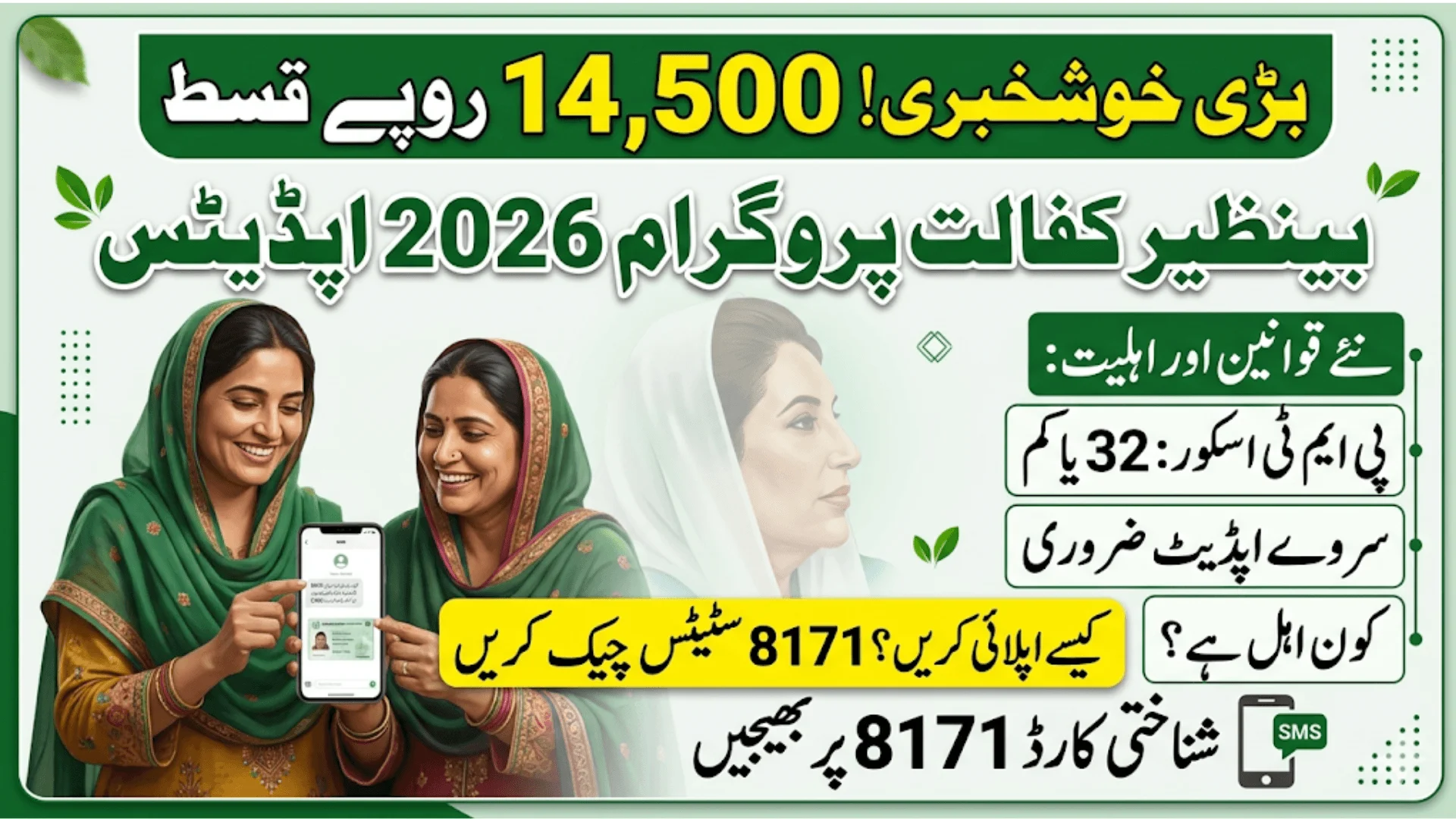
Benazir Kafaalat Program Updated Rules 2026
Benazir Kafaalat Program: Millions of Pakistani women registered under the Benazir Income Support Program woke up to a significant change this year. The government has officially revised the Benazir Kafaalat payment structure and eligibility criteria for 2026, and the update affects a large portion of existing beneficiaries in ways many have not yet realized. The quarterly payment has been confirmed at Rs.14,500, but receiving it is no longer automatic. BISP has tightened the verification process, updated the PMT (Proxy Means Test) score thresholds, and introduced new disqualification conditions that did not exist in previous years.

If your CNIC-linked survey data has not been refreshed, or if your household income situation has changed, your payment status could already be affected. What exactly has changed, who still qualifies, and what steps do you need to take right now? Here is everything you need to know before the next disbursement cycle opens.
Also Read: Punjab Schools Summer Vacation 2026 Schedule Announced
Benazir Kafaalat Program 2026: Key Facts at a Glance
| Detail | Information |
| Program Name | Benazir Kafaalat (under BISP) |
| Payment Amount | Rs.14,500 per quarter |
| Payment Frequency | Every 3 months (quarterly) |
| Eligibility Score | PMT score 32 or below |
| Target Beneficiaries | Low-income women, Pakistan-wide |
| Verification Method | CNIC-based NSER survey + biometric |
| Helpline | 8171 (free, all networks) |
What Has Actually Changed in Benazir Kafaalat 2026?
The biggest shift this year is that BISP has moved from a passive to an active verification model. Previously, once a woman was registered and approved, her payments continued with minimal re-checking. In 2026, the National Socioeconomic Registry (NSER) data is being cross-matched with FBR tax records, NADRA household data, and provincial land records in real time. Any mismatch or unreported income source can trigger an automatic payment hold.
The government has also changed how the PMT score is calculated. Certain household indicators, such as ownership of a motorcycle, number of mobile SIMs registered under household members, and children enrolled in private schools, are now weighted more heavily in the scoring formula. This means some families who previously scored below the threshold may now fall above it, making them ineligible without any change in their actual financial situation on the ground.
Who Qualifies for the Rs.14,500 Quarterly Payment?
The core eligibility framework targets women who are the primary household decision-makers and who belong to families with no significant income sources. BISP defines “low income” through the PMT scoring system rather than a fixed salary figure, which means eligibility is determined by a combination of household characteristics rather than a single income declaration.
To be counted as eligible under the 2026 updated rules, an applicant must meet all of the following conditions without exception:
- Must be a Pakistani female citizen with a valid, active CNIC issued by NADRA
- Household PMT score must be 32 or below as per the latest NSER survey
- Must not be a current or retired government employee, or have a spouse in government service
- Household must not own more than two acres of irrigated land or four acres of non-irrigated land
- No household member should be a registered taxpayer with FBR
- Must not already be receiving any other federal cash transfer benefit from the government
- CNIC must not be expired, blocked, or pending renewal with NADRA
Also Read: 8171 Portal Status Check Solving SIM Eligibility And Registration Issues
Common Reasons Payments Are Being Stopped in 2026
BISP has publicly stated that a large number of payment suspensions in early 2026 are linked to data mismatches rather than actual ineligibility. Many women whose families have seen minor income improvements, or whose household survey data is years old, are finding their payments on hold when they visit payment centers.
The following are the most frequently reported disqualification triggers identified through BISP’s own reporting and community-level feedback from districts including Rahim Yar Khan, Kashmore, and Tharparkar:
- CNIC expired or not renewed in the last two years
- A family member recently registered a vehicle or property without updating NSER data
- Duplicate registration detected under the same household
- Biometric verification not completed at the assigned payment point
- Household survey data not updated after a family member joined formal employment
- Mobile number linked to CNIC not reachable or changed without informing BISP
How to Apply for Benazir Kafaalat Program 2026
New applicants and those whose payments were recently suspended both follow a similar process, though the documentation required differs slightly. BISP has expanded its tehsil-level facilitation centers across all four provinces and Azad Kashmir to handle the increased volume of registrations and complaints that came with the 2026 rule changes.
For fresh applicants, the registration process now requires an in-person visit because biometric confirmation cannot be done remotely. The 8171 SMS service can be used to check your eligibility status before visiting the office, which saves time if your data is already in the NSER system.
Step-by-step registration process
- Send your CNIC number to 8171 via SMS to check your current BISP status
- If not registered, visit your nearest BISP Tehsil Office with your original CNIC
- Request an NSER survey registration form and fill it out honestly with current household details
- A BISP surveyor will visit your home to conduct the PMT assessment, usually within 30 to 60 days
- Once the score is calculated and falls at or below 32, you will receive an eligibility confirmation SMS
- Visit the designated payment point (HBL, UBL, or assigned agent) with your CNIC for biometric and first disbursement
Also Read: Ehsaas/BISP Program Closure Rumors Official May 2026 Payment Details
How to Check Your Payment Status Without Visiting an Office
BISP has made it possible for registered beneficiaries to track their payment status through two digital methods. The first is the 8171 SMS service, where you send your 13-digit CNIC number and receive a reply within minutes showing your registration status, payment amount due, and the nearest payment location assigned to your CNIC.
The second option is the BISP web portal available at bisp.gov.pk, where you can enter your CNIC number and check the same information online. Many beneficiaries in urban centers like Karachi, Lahore, and Faisalabad prefer the web portal, while those in rural tehsils rely on the SMS route due to limited internet access. Both methods are free and do not require any middleman or agent.
Payment Schedule and Disbursement Points for 2026
The Rs.14,500 quarterly payment is disbursed four times a year, with each cycle lasting approximately three months. BISP coordinates with designated bank branches and retail agent points across Pakistan to ensure coverage even in remote union councils. In 2026, HBL Konnect and UBL Omni have been confirmed as the primary disbursement partners alongside the BISP-issued payment cards.
- Payments are released in batches by district and tehsil, not all at once nationwide
- Beneficiaries receive an SMS notification two to three days before their payment is available
- Biometric thumb impression is required at the payment point on each collection
- If you miss a disbursement window, the amount rolls over to the next cycle in most cases
- Lost or damaged payment cards can be replaced at the BISP Tehsil Office
Also Read: How To Do BISP Check Balance Online By CNIC 2026 Updated & Verified Process
Frequently Asked Questions
Can a widow apply for Benazir Kafaalat even if she has adult sons?
Yes, a widow can apply, but if an adult son is an FBR taxpayer or formally employed, it may push the household PMT score above the eligibility threshold of 32.
What happens if my CNIC expires? Will my Benazir Kafaalat payment stop?
Yes, expired CNIC is a top reason for payment suspension in 2026. Renew it at NADRA and update your record via the 8171 helpline immediately.
Is Rs.14,500 the final quarterly amount or will it increase later in 2026?
Rs.14,500 is the confirmed amount for the current BISP cycle. No official increase is scheduled, though advocacy groups have pushed for a revision due to inflation.
Can I register for Kafaalat online without visiting the BISP office?
No, first-time registration requires an in-person visit for biometric verification. You can check eligibility first via SMS at 8171 to save time.
My payment was stopped without any notice. What should I do?
Send your CNIC to 8171 to check your status, then visit your nearest BISP Tehsil Office with your original CNIC to resolve any data mismatch.
Does owning a mobile phone or a motorcycle disqualify someone from Kafaalat?
It affects your PMT score but does not automatically disqualify you. Final eligibility depends on the total household score, not any single asset alone.
Is there a separate program for women in Balochistan or FATA areas?
No, Benazir Kafaalat runs under one national BISP framework covering all provinces. Disbursement in remote areas is handled through scheduled mobile payment teams.
Conclusion
The Benazir Kafaalat Program 2026 pays Rs.14,500 per quarter to eligible low-income women across Pakistan. To qualify, your BISP PMT score must be 32 or below, your CNIC must be active, and your household must not own taxable assets or have a salaried government employee. Registration is done via BISP tehsil offices or the 8171 helpline.
The 2026 changes to Benazir Kafaalat reflect a broader government push toward verified, data-driven social protection rather than broad-based distribution. For genuine beneficiaries, the updated system offers more transparency, but it also demands active participation, especially in keeping CNIC and NSER data current. The next disbursement cycle is worth preparing for well in advance rather than discovering a problem at the payment counter.
Also Read: How To Get 3000 Rupees From Sindh Government Through CNIC Without Any Agent