

QR Panic Buttons Now Mandatory
If you travel by rickshaw, taxi, or ride-hailing app in Lahore, something significant changed this week. The city’s traffic police have set a hard deadline, and vehicles that miss it will face direct legal action starting July 1, 2026. Lahore Traffic Police announced that a crackdown will begin from July 1 against public transport vehicles that have not installed the mandatory QR panic buttons and other required security features.
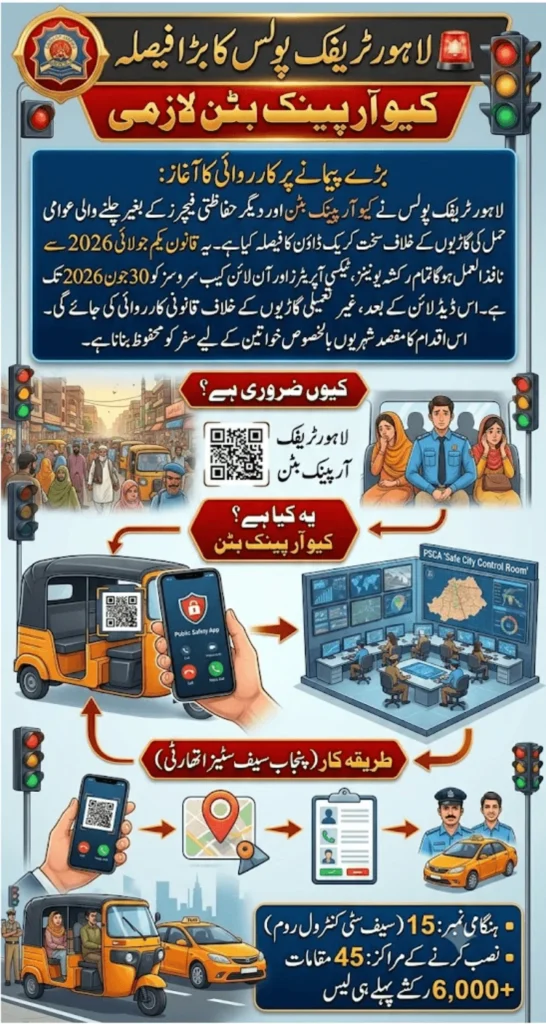
Chief Traffic Officer Syed Abdul Rahim Shirazi confirmed that all rickshaw unions, taxi operators, online cab services, and other public transport providers were given until June 30 to comply.This is not a suggestion or a pilot program. The deadline has passed and enforcement is now active. Here is everything you need to know.
Also Read: Nalka Chor, Fan Chor” Punjab Minister’s Shocking Remarks On Teachers
Quick Answer
What is the QR panic button rule in Lahore?
Punjab Safe Cities Authority introduced the CM Punjab QR Panic Button System for public transport vehicles. Passengers can scan a QR code at the start of their journey to access verified vehicle and driver information and contact the Safe City Control Room through call, video call, or live chat during any emergency.
Key Facts Table Quick Information
| Detail | Information |
| Enforcement Date | July 1, 2026 |
| Compliance Deadline | June 30, 2026 |
| Vehicles Covered | Rickshaws, taxis, online cabs, buses, wagons |
| Authority | Lahore Traffic Police / PSCA |
| Emergency Number | 15 (Safe City Control Room) |
| Installation Points | 45 locations across Lahore |
| Rickshaws Already Equipped | 6,000+ |
Also Read: Oppo Reno16 F Series Revealed With All-Day Battery And High-Quality 4K Selfie Recording
What Exactly Is the QR Panic Button System?
The Punjab Safe Cities Authority introduced the CM Punjab QR Panic Button System for public transport vehicles across the province, giving passengers and drivers a direct digital link to emergency police support during travel. The system covers buses, wagons, rickshaws, taxis, and other public transport vehicles. The idea is straightforward. A QR code is physically fixed inside the vehicle. When a passenger feels unsafe, they scan it and get immediate access to emergency services without needing to know any numbers or type anything.
The new system includes 12 modern features, among them call, video call, live chat, location sharing, vehicle verification, and immediate police response. In an emergency, passengers can contact the Safe City Control Room through any of these options, while their live location and vehicle data are transmitted instantly to the control room.
Which Vehicles Are Being Targeted?
Authorities ordered a crackdown on rickshaws, public transport vehicles, and online ride-hailing cabs that do not comply with the new safety requirement. Special monitoring teams have been deployed across all traffic sectors to oversee installation and compliance, and 12 dedicated teams have been specifically assigned to monitor rickshaws.
The enforcement is structured and sector-specific, not a random sweep. Every category of public transport is being tracked separately.
Also Read: BISP Taleemi Wazaif How To Register Your Child And Get Monthly Education Stipend
How Passengers Benefit From This System
Passengers facing danger can scan the code to transmit their live location and specific vehicle details immediately to the police and the Punjab Safe Cities Authority. The City Traffic Police Lahore coordinates directly with the PSCA to dispatch rapid responses to any incoming alerts.
Chief Minister Maryam Nawaz also addressed the system’s purpose directly. She stated that with a simple scan, passengers can instantly verify vehicle and driver details, share their live location with family members, and connect with Emergency-15 through voice call, video call, or live chat in any emergency. She added that the safety of women, girls, children, senior citizens, and every commuter remains her top priority.
Key Features of the QR Panic Button
- Passengers can verify driver and vehicle identity before the trip begins
- Live location is shared with the Safe City Control Room during an emergency
- Contact options include voice call, video call, and live chat on 15
- If vehicle ownership changes, the previously issued QR Panic Button becomes inactive, and a new one is issued only after updated ownership and driver information are verified.
- Citizens can also get free QR panic buttons through the Public Safety App and Safe City website.
- The system is built on technology developed entirely by PSCA
How Is Lahore Traffic Police Ensuring Compliance?
To facilitate compliance, the traffic police are installing QR panic buttons at 45 locations across the city. Dedicated teams have also been deployed in every traffic sector, including 12 teams assigned exclusively to rickshaws. More than 6,000 rickshaws have already been equipped with QR panic buttons during the ongoing campaign.
Licensing support is also being expanded so drivers are not blocked by paperwork. Four new licensing centres have been established at the request of various rickshaw unions to facilitate drivers.This shows the approach is not purely punitive. The administration is making the process accessible before penalizing those who still do not act.
Also Read: Punjab Boards Result Schedule 2026 Announced Complete Dates For 9th, 10th, 11th & 12th Class Results
What Happens to Non-Compliant Vehicles?
The Lahore Traffic Police decided to launch strict enforcement action against public transport vehicles that fail to install mandatory QR panic buttons, as part of a broader effort to improve passenger safety and strengthen transport security across the city. The initiative aims to ensure all vehicles meet updated legal and safety standards.
Vehicles found operating without the required feature after July 1 will face legal action. The exact penalties have not been publicly listed in detail, but “legal action” under traffic law in Punjab can include fines, suspension of route permits, and challan proceedings.
Why This Matters for Women and Daily Commuters
Public transport safety is not just a policing issue. It directly affects women, students, senior citizens, office workers, and daily commuters who rely on buses, wagons, rickshaws, and taxis for routine travel. In many cases, the problem is not only the crime itself, but the lack of immediate traceability when something goes wrong. The QR Panic Button system addresses that gap by linking vehicle identity, passenger location, and police response through one digital channel.
This is the real value. Crimes or incidents on public transport often go unreported or unresolved because there is no quick way to identify the vehicle after the fact. A scannable, registered QR code changes that entirely.
Is This Expanding Beyond Lahore?
Yes. Rawalpindi has also started installing QR panic buttons and GPS tracking in public transport vehicles, giving passengers a faster way to alert police and Safe City teams during emergencies. The rollout appears to be a province-wide direction, not limited to the provincial capital.
Also Read: Sindh Sasti Basti Housing Scheme 2026 Announced Check Eligibility & Apply Online
FAQ
Q1. What is the QR panic button in Lahore public transport?
It is a scannable code fixed inside vehicles that connects passengers directly to the Safe City Control Room and shares their live location during an emergency.
Q2. Which vehicles need QR panic buttons in Lahore?
Rickshaws, taxis, buses, wagons, and online ride-hailing cabs are all required to install them.
Q3. What is the deadline for QR panic button installation in Lahore?
The deadline was June 30, 2026. Crackdown enforcement began July 1, 2026.
Q4. How do passengers use the QR panic button?
They scan the code inside the vehicle, which opens a direct link to Emergency 15 with options for call, video call, or live chat, along with automatic location sharing.
Q5. Is the QR panic button system free for drivers?
Yes. Installation support is being provided at 45 points across Lahore, and citizens can also access the system through the Public Safety App.
Q6. What happens if a vehicle owner sells the rickshaw or taxi?
The existing QR code becomes invalid. A new one is issued only after the updated ownership and driver records are verified by PSCA.
Q7. Will this system expand to other Punjab cities?
Rawalpindi has already started its own rollout, and the system is designed as a province-level initiative under CM Punjab’s public safety program.
Conclusion
Lahore’s QR panic button mandate marks a shift in how passenger safety is being handled in Pakistani cities, moving from reactive policing to real-time digital accountability. With over 6,000 rickshaws already equipped and enforcement now active, the pressure on remaining transport operators is real. Whether this pushes public confidence in Lahore’s streets upward depends on how consistently it is enforced over the coming months, not just in the first week. The bigger question is whether other major cities like Karachi and Faisalabad will follow before incidents force their hand. For now, anyone commuting in Lahore should know the system exists and how to use it if needed.
Also Read: Pakistan’s First Free Public Cancer Hospital To Open Soon As Official Date Is Announced