
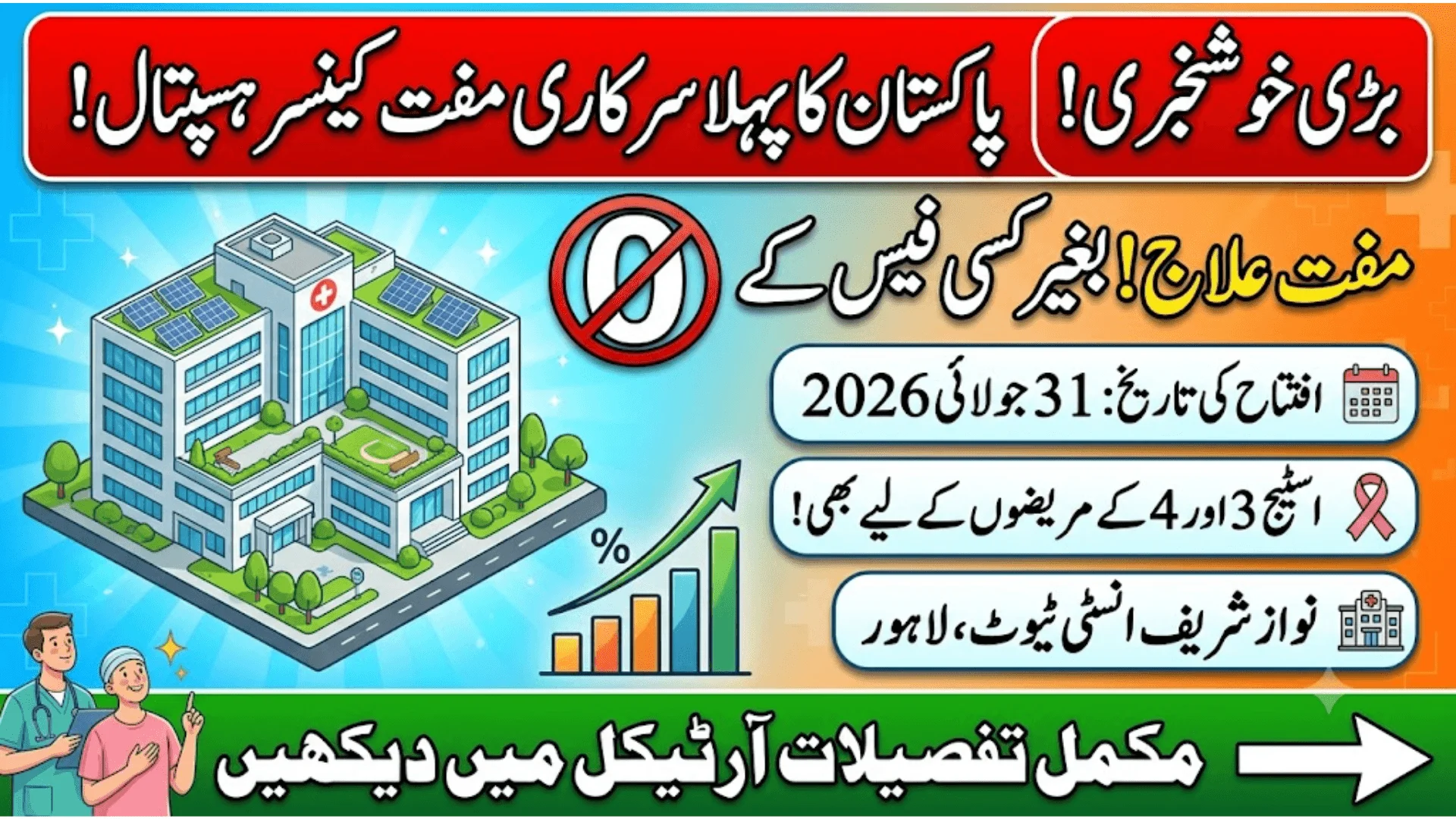
Pakistan’s First Free Public Cancer Hospital
Pakistan’s First Free Public Cancer Hospital: Millions of cancer patients in Pakistan have been waiting for this moment for years, and now it finally has a date. The Punjab government has officially confirmed July 31, 2026 as the inauguration date for the Nawaz Sharif Institute of Cancer Treatment and Research in Lahore. This is not a private charity hospital or an NGO project. This is the first hospital of its kind to be fully funded and operated by the government of Pakistan, and treatment will be available at zero cost to patients.
What makes this announcement even more significant is who it covers. The facility will provide free treatment to patients at stage three and stage four cancer, the most advanced and financially crushing stages of the disease. For families who have spent their savings trying to keep a loved one alive, this development represents something they have rarely seen from a public health institution in this country.
Also Read: Jazz Monthly Bachat Offer Know About Pakistan’s Most Affordable Bundle
Quick Answer
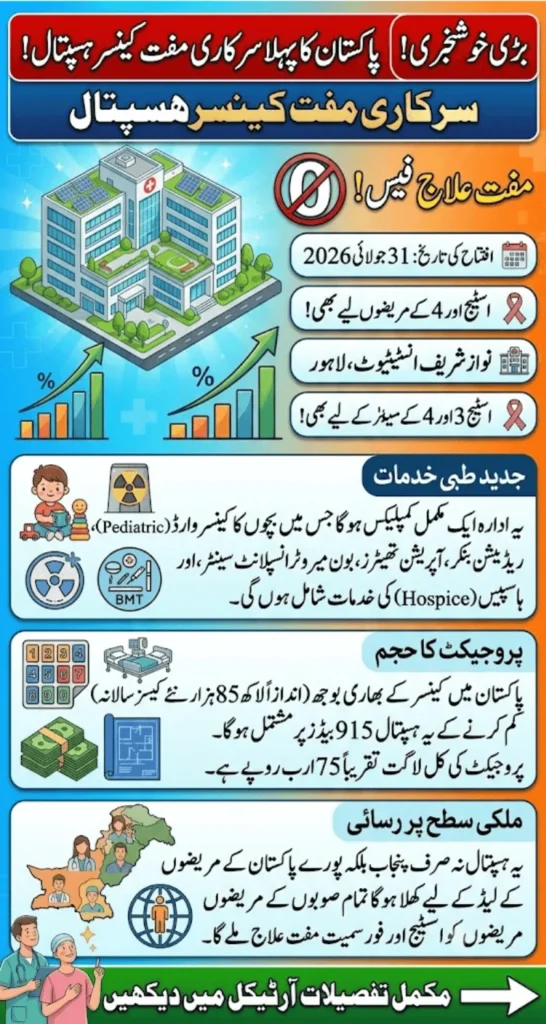
The Nawaz Sharif Institute of Cancer Treatment and Research, located in Valencia Town, Lahore, will be inaugurated on July 31, 2026. It is Pakistan’s first fully government-run cancer hospital offering free treatment, including to stage 3 and stage 4 patients. The complete project will have 915 beds and is being developed in phases at a total cost of approximately Rs. 75 billion.
Key Facts
| Detail | Information |
| Hospital Name | Nawaz Sharif Institute of Cancer Treatment and Research |
| Inauguration Date | July 31, 2026 |
| Location | Valencia Town, Lahore |
| Total Planned Bed Capacity | 915 beds |
| Total Project Cost | Rs. 75 billion (approx.) |
| Treatment Cost for Patients | Free |
| Foundation Stone Laid | October 2024 by CM Maryam Nawaz |
| Eligibility | Punjab residents and patients from other provinces |
Also Read: CM Punjab Women’s Textile Training Program 2026
Why July 31 Is the Official Opening Date
Punjab Chief Minister Maryam Nawaz was briefed that Packages A and B of the hospital project would be completed by July 31. The provincial government then formally approved the same date as the inauguration day. This is not a soft launch or a limited trial. The government has pushed forward with recruiting staff, setting up digital systems, and finalizing construction of the core facilities to meet this deadline.
The institute sits in Valencia Town, Lahore, with access routes connecting directly to the motorway and Lahore Ring Road. That kind of road connectivity matters for cancer patients traveling from Faisalabad, Multan, Gujranwala, and other parts of Punjab who would otherwise rely on local transport to reach a specialist facility.
What Services Will the Hospital Offer?
This is where the hospital separates itself from any existing public health facility in the country. The range of services planned goes well beyond a basic oncology ward.
The project includes a main hospital building alongside a specialized clinic that will offer diagnostic services, chemotherapy, radiology, pharmacy services, and bone marrow treatment.
Key medical departments and facilities confirmed for the institute:
- Pediatric oncology ward for children with cancer
- Radiation therapy with 10 dedicated bunkers
- Operation theatres and intensive care units
- A 30-bed emergency department for urgent cancer cases
- A hospice facility for patients requiring end-of-life palliative care
- Bone marrow transplant centre, announced as Pakistan’s first in the public sector
The campus will also include accommodation for doctors and staff, an energy centre, and supporting infrastructure. This suggests the government is planning for this to function as a self-contained medical campus rather than just a standalone building.
Also Read: Bad News For Apple Fans MacBooks And iPads May Soon Cost Much More In Pakistan
Free Treatment for Stage 3 and Stage 4 Patients
The single detail that changes everything for ordinary Pakistani families is this: authorities plan to provide free treatment to cancer patients, including those suffering from stage three and stage four cancer, and patients from Punjab and other provinces will also be able to receive treatment at the institute.
Stage 3 and stage 4 treatment at private hospitals in Pakistan can cost anywhere from Rs. 5 lakh to Rs. 30 lakh or more per patient depending on the type of cancer and the required interventions. Chemotherapy cycles, radiation sessions, surgical procedures, and post-treatment monitoring drain family finances fast. The government has acknowledged this reality by making access free at the point of care.
Digital and Paperless Hospital Operations
The government plans to operate the institute through a digital and paperless system, with officials believing the system will improve transparency, record management, and hospital efficiency. This is a significant operational commitment. Digital record management in public hospitals has historically been a weak point across Pakistan’s health infrastructure. If the Nawaz Sharif Institute genuinely implements a paperless system from day one, it could set a benchmark that other government hospitals are pressured to follow.
Also Read: BISP 14500 Payment 2026 Confirmed 8171 Portal, Account Restoration & Taleemi Wazaif Details
Recruitment Drive Already Underway
The Punjab government has already started recruiting clinical and non-clinical employees for the institute, with positions advertised including specialists in radiation oncology and other medical disciplines, along with administrative and support roles.
The fact that hiring is already in progress before the July 31 date suggests the government is treating this as a real operational launch rather than a ribbon-cutting ceremony with an empty building. Radiation oncology is a specialty that requires trained physicians, physicists, and dosimetrists. Advertising those positions ahead of inauguration indicates the intent to have clinical teams in place before patients arrive.
How Big Is Pakistan’s Cancer Problem?
To understand why this hospital matters, consider the scale of the challenge. Pakistan faces a significant cancer burden, with an estimated 185,748 new cases diagnosed in 2022. That figure has continued to grow. The existing public sector infrastructure has struggled to absorb that volume. The Pakistan Atomic Energy Commission operates 19 Atomic Energy Cancer Hospitals across the country and caters to over 40,000 new cancer cases with 1 million procedures per year, taking on roughly 80% of the country’s cancer burden.
Those hospitals do important work, but they were never designed to be the only answer. A dedicated, fully equipped government cancer institute was a gap that has existed for decades. Pakistan’s childhood cancer survival rate currently sits at around 30%, compared to 80% in higher-income countries, with limited access to treatment identified as one of the main contributing factors. The Nawaz Sharif Institute, with its planned pediatric oncology ward, is positioned to address at least part of that disparity.
Also Read: CM Punjab SEHR Program 2026 Eligibility, Training Courses, Benefits & How To Apply
Project Background and Cost
Chief Minister Maryam Nawaz laid the foundation stone of the hospital and assigned a 12-month target for the completion of the first phase. The foundation ceremony took place in October 2024, meaning the Phase 1 construction timeline runs roughly 9 to 10 months from groundbreaking to inauguration. The complete project is estimated to cost around Rs. 75 billion and will have a planned capacity of 915 beds, being developed in phases.
Compared to private cancer centres in Pakistan, where the cost of a single treatment cycle can exceed what a middle-income family earns in a year, the scale of this public investment is significant.
Will Patients From Outside Punjab Be Accepted?
Yes. The government has confirmed that patients from other provinces will also be eligible to seek treatment at the institute. This is a critical point because cancer care inequality in Pakistan is not just about income, it is also about geography. Patients from Balochistan, Khyber Pakhtunkhwa, and interior Sindh have historically had fewer options than those in major urban centres.
Also Read: JazzWorld Launches International Roaming Deal For Iraq And Iran Ziyarat Travelers
FAQ
When will the Nawaz Sharif Institute of Cancer Treatment and Research open?
The official inauguration date is July 31, 2026, confirmed by the Punjab government after construction of Packages A and B reached completion.
Where is the new government cancer hospital in Lahore located?
The hospital is in Valencia Town, Lahore, with direct road access from the Lahore Ring Road and the motorway network.
Who can get free cancer treatment at this hospital?
Patients from Punjab and other provinces of Pakistan are eligible. Free treatment covers all cancer stages, including advanced stage 3 and stage 4 cases.
How many beds will the Nawaz Sharif Cancer Hospital have?
The completed hospital will have a capacity of 915 beds. The facility is being built and opened in phases, with the initial opening covering Packages A and B.
What types of cancer treatment will be available?
Services include chemotherapy, radiation therapy with 10 bunkers, surgical oncology, bone marrow transplant, pediatric oncology, palliative care, and emergency cancer care.
How much will treatment cost at this public cancer hospital in Pakistan?
Treatment will be free of charge for patients, funded by the Punjab government.
Has Pakistan had a government-run cancer hospital before?
No. This is the first fully government-run cancer hospital in Pakistan’s history. Previous public cancer facilities were operated by institutions like the PAEC or were NGO-funded, not directly by a provincial government.
What Comes Next
July 31, 2026 is close. Whether the hospital opens on schedule or faces last-minute delays will be watched closely, both by patients who need it and by those who have long questioned whether large public health promises in Pakistan ever translate into functioning institutions. If the Nawaz Sharif Institute delivers on even a portion of what has been announced, it could shift the benchmark for publicly funded healthcare in the country.
The more important question is not whether it opens, but whether it sustains that standard of care in the years that follow. Pakistanis have seen inaugurations before. What they have rarely seen is consistent, accessible, quality care that survives the political cycle.
Also Read: BISP 8171 Online Wallet Registration 2026