
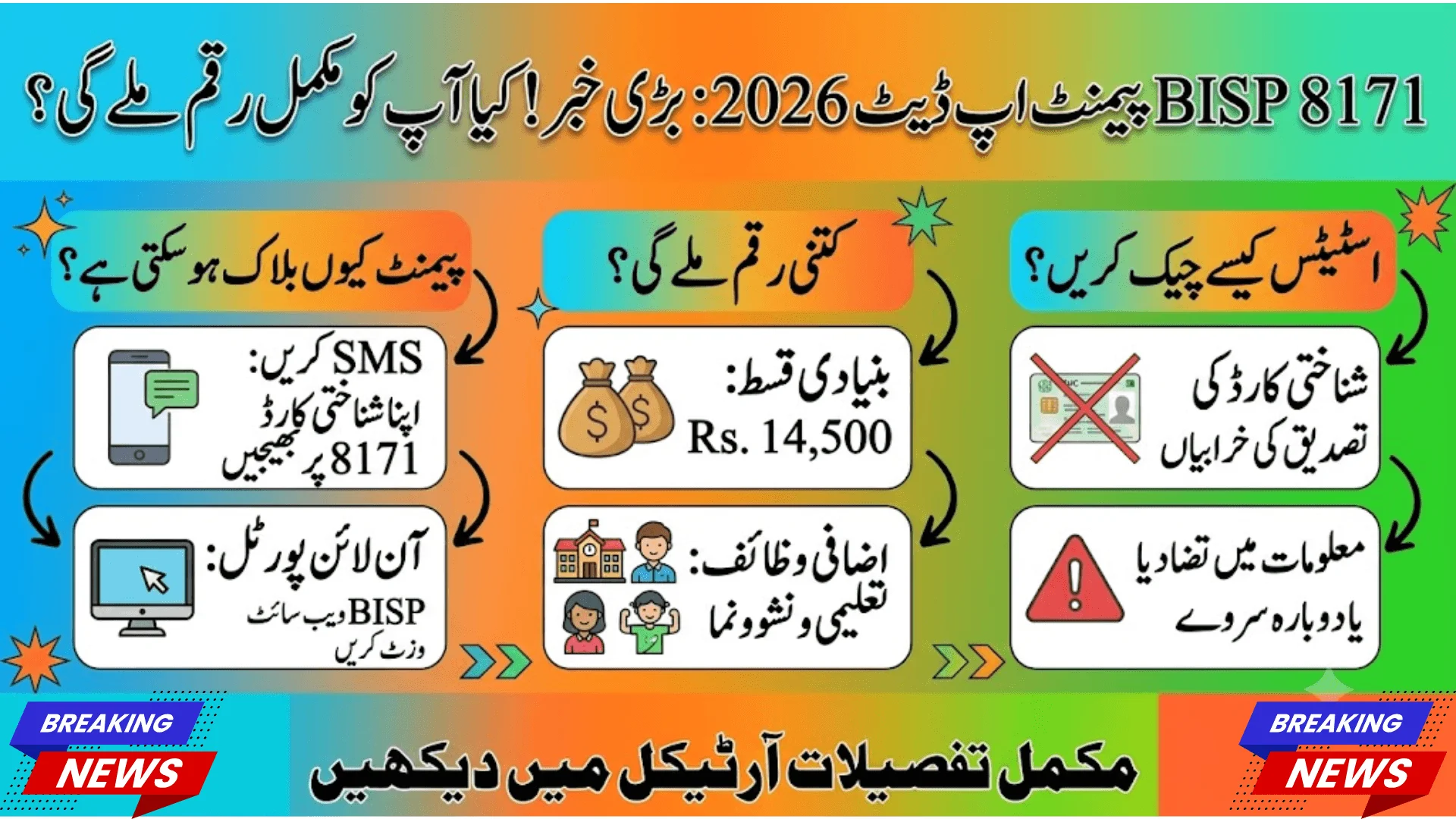
BISP 8171 New Payment Update 2026
BISP 8171 New Payment: Millions of registered families across Pakistan have been waiting for one message and the wait may finally be over. The Benazir Income Support Program has rolled out a fresh payment cycle for 2026, and this time the process for checking eligibility and receiving funds has been updated significantly. If you have not checked your 8171 portal status in the last few weeks, you could be missing out on your approved quarterly installment. Many beneficiaries are unaware that their payment status shows “pending” simply because of an unresolved CNIC verification issue, not a disqualification.

This article covers everything you need to know about the BISP 8171 new disbursement cycle, how to check your status right now, and what to do if your payment has been blocked or delayed.
Also Read: How To Apply For The CSS PITC Subsidy Program 2026
Quick Answer
BISP has started the 2026 quarterly payment cycle. Registered beneficiaries can check their status by sending their CNIC number to 8171 via SMS or visiting the official BISP web portal. Approved families will receive Rs. 10,500 per installment through designated HBL, UBL, and Habib Metro payment points or Kafalat cards.
Table Key Information
| Detail | Information |
| Programme Name | Benazir Income Support Program |
| Payment Amount | Rs. 14500 per quarterly installment |
| Check Method | SMS to 8171 or bisp.gov.pk portal |
| Payment Points | HBL, UBL, Habib Metro, Kafalat Card |
| Eligibility Check | CNIC-based verification |
| Helpline | 0800-26477 (Toll-Free) |
Also Read: Pakistan Announces Massive Tax Increase On Imported Luxury And Electric Cars
How the 8171 CNIC Status Check Works in 2026
The BISP status verification system has gone through a quiet but meaningful upgrade this year. The old method of just sending your CNIC to 8171 still works, but the response messages have become more specific. Instead of a generic “eligible” or “not eligible” reply, beneficiaries now receive messages that indicate exactly which stage their case is at, whether it is under survey review, payment processing, or already disbursed.
To check your status, open your phone’s messaging app and type your 13-digit CNIC number without dashes. Send this message to 8171. Within a few minutes, you will receive a reply from the system. If the message says your payment is approved, you can visit the nearest payment centre to collect your installment. If it says your record is under review, you may need to visit your local BISP tehsil office with original documents.
Who Gets Rs. 14,500 and Who Gets More
The base payment for most registered households under the Kafaalat programme remains Rs. 10,500 per quarter. However, families enrolled in the Taleemi Wazaif (education stipend) and Nashonuma (nutrition) components receive additional amounts on top of the base figure. A household with three school-going children registered under Taleemi Wazaif, for instance, can receive a combined quarterly disbursement that goes significantly beyond the base amount.
BISP’s district offices in cities like Lahore, Karachi, Quetta, and Peshawar have confirmed that payments for the current cycle are being released in phases across provinces. Punjab-based beneficiaries were among the first to see their Kafalat card balances updated, with Sindh and KP following shortly after.
Also Read: Ufone 5G Pakistan’s Trusted Telecom Brand Empowering Millions Across the Nation
Why Your Payment May Be Blocked Right Now
CNIC Verification Failure
One of the most common reasons a payment gets held up is a mismatch in the CNIC database. If your national identity card has expired, or if your details in the NADRA system do not match what BISP has on record, your installment will not be released.
- Expired CNIC not renewed at NADRA
- Address mismatch between BISP survey and NADRA data
- Death of a registered beneficiary with no update to BISP records
- Duplicate household registration flagged by the system
PMT Score Reassessment
BISP uses a Proxy Means Test score to determine financial eligibility. Households that were surveyed years ago and have since changed their economic situation, or whose neighbours have reported changes, may be flagged for reassessment. This does not automatically mean disqualification, but it does pause payments until the reassessment is complete.
How to Register for BISP If You Are Not Already Enrolled
Many deserving families in rural Sindh, South Punjab, and Balochistan still have not been formally registered despite meeting the income criteria. The government has been running survey campaigns through the National Socio-Economic Registry (NSER) to bring more households into the system. If you believe you qualify but have never been registered, here is what you should do:
- Visit your nearest BISP division or tehsil office with your original CNIC and a household electricity or gas bill
- Ask for an NSER survey update form
- Ensure all family members above 18 have valid CNICs before the survey
- Provide accurate income and asset information during the interview
BISP officials have specifically warned against providing false information during surveys, as households caught misrepresenting their financial status face permanent disqualification.
Also Read: BISP June Payment Not Received? Know Why Your 8171 Stipend Is Blocked
Checking Your Status Online Through the BISP Portal
Beyond the SMS method, the BISP official website at bisp.gov.pk also has a dedicated beneficiary status check section. You enter your CNIC number and a verification code, and the system shows your current payment stage in real time. This method is more detailed than the SMS reply and shows your payment history, current programme enrollment, and any pending issues on your account.
The portal is accessible from any smartphone browser and does not require any app download. However, during peak traffic periods, especially right after major payment announcements, the portal can slow down. Early morning access between 6 AM and 9 AM tends to give faster results.
BISP Payment Collection What to Bring to the Payment Centre
When your SMS reply or portal check confirms that your payment is ready, you need to visit an authorised payment point to collect it. Most beneficiaries use the Kafalat debit card, which works at designated bank branches and certain ATMs. For those without cards, manual over-the-counter collection is still available at selected HBL and UBL branches across the country.
Documents Required for Collection
- Original CNIC (not a photocopy)
- BISP Kafalat card (if issued)
- Registered mobile number that matches your BISP record
- A thumbprint will be required at the payment counter
If you send someone else to collect on your behalf, BISP does not allow proxy collections under the current policy. The registered beneficiary must be physically present.
Also Read: BISP 14500 July Stipend 2026 8171 CNIC Check Method Step by Step
What Changed in the 2026 Payment Policy
BISP’s 2026 disbursement round introduced a few policy changes that directly affect beneficiaries:
- Dynamic NSER resurveys are now being conducted in flood-affected areas of Sindh and Balochistan, adding new households mid-cycle
- Beneficiaries with three consecutive “uncollected” payment records may be temporarily suspended pending a field visit
- The helpline number 0800-26477 has been expanded to handle Balochi and Sindhi language queries in addition to Urdu
- Taleemi Wazaif payments are now being tied to biometric attendance records from schools, meaning children must maintain a minimum attendance percentage
FAQ
Q1: How do I check my BISP 8171 payment status by SMS?
Send your 13-digit CNIC number (without dashes) to 8171 and you will receive an automatic reply showing your current payment status within minutes.
Q2: What is the BISP quarterly payment amount in 2026?
The base Kafaalat payment remains Rs. 14,500 per quarter, with additional amounts available for families enrolled in education and nutrition sub-programmes.
Q3: Can I check my BISP status online without SMS?
Yes, visit bisp.gov.pk and use the beneficiary status check tool by entering your CNIC number and a verification code.
Q4: What should I do if my BISP payment is showing pending?
Visit your nearest BISP tehsil office with your original CNIC and supporting documents. A pending status often means a CNIC verification or survey issue that can be resolved in person.
Q5: Is BISP registration open for new families in 2026?
Yes, NSER survey campaigns are ongoing in multiple districts. Families who have not been previously surveyed can visit a BISP division office to request an enrollment interview.
Q6: Why did I receive an SMS saying I am not eligible?
A not-eligible reply usually means your PMT score is above the programme threshold, your CNIC details do not match NADRA records, or your household has already been disqualified due to a previous policy issue.
Q7: Can I collect my BISP payment from any bank?
Kafalat card payments are collected from designated HBL, UBL, and Habib Metro branches. Not every branch of these banks processes BISP payments, so check with your local BISP office for the nearest authorised point.
Conclusion
The BISP 8171 system remains one of Pakistan’s most widely used social protection tools, and the 2026 payment cycle brings both improvements and new requirements that beneficiaries should understand clearly. Checking your status through SMS or the official portal takes less than two minutes, but many families skip this step and then wonder why their payment has not arrived. If your status shows any issue, the fastest resolution is a direct visit to your BISP tehsil office with valid documents rather than waiting for the problem to resolve on its own.
Staying aware of policy updates, especially the new biometric and attendance-linked conditions for sub-programme payments, will help you avoid surprises in the next disbursement round. The programme continues to evolve, and registered families who stay informed are far less likely to face unnecessary delays in receiving the financial support they are entitled to.
Also Read: VibeThinker-3B The Small AI Model That Is Outshining The Giants