
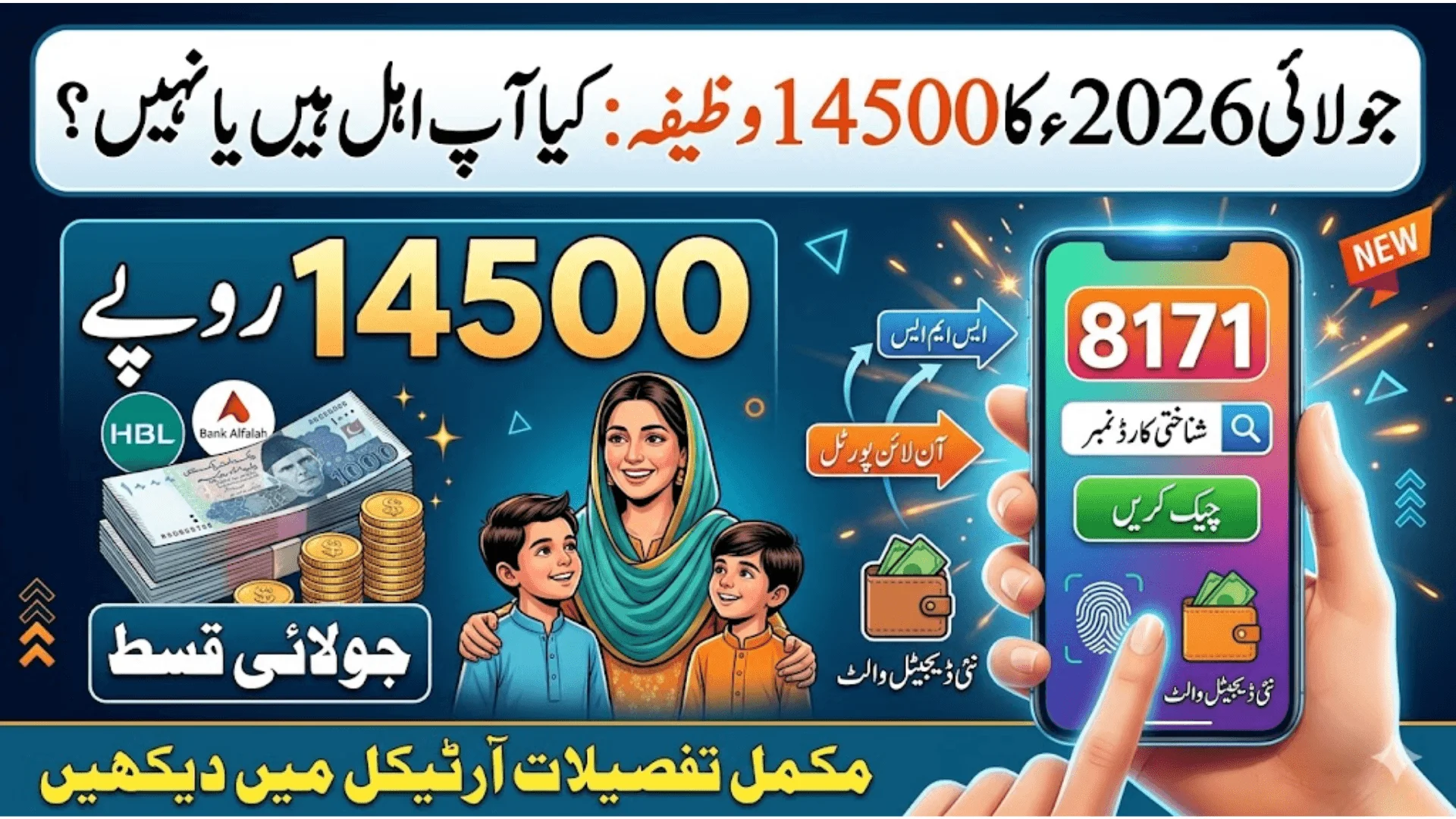
BISP 14500 July Stipend 2026 8171 CNIC Check
BISP 14500 July Stipend: For many families across Pakistan, receiving financial assistance through the Benazir Income Support Program is an important source of support. In the past, beneficiaries often had to visit government offices, wait in long lines, and spend valuable time and money just to find out whether their payment had been released. Fortunately, the introduction of the 8171 service has made the process much easier and more convenient. Now, eligible individuals can check the status of their BISP July 2026 stipend of Rs. 14,500 from the comfort of their homes by using their Computerized National Identity Card (CNIC) number.

Whether you have access to the internet or only a basic mobile phone, the system provides simple ways to verify payment information. This guide explains the complete 8171 CNIC checking process step by step, including how to use the online portal, how to check through SMS, and what different eligibility and payment status messages mean for beneficiaries.
Also Read: VibeThinker-3B The Small AI Model That Is Outshining The Giants
Quick Information Table
| Detail | Information |
| Program Name | Benazir Income Support Programme (BISP) |
| Current Quarterly Stipend | Rs. 14,500 per eligible household |
| Chairperson | Rubina Khalid |
| Official Web Portal | 8171.bisp.gov.pk |
| SMS Short Code | 8171 |
| Required Document | 13-digit CNIC |
| Database Used | National Socio-Economic Registry (NSER) |
| Linked Sub-Programs | Kafaalat, Taleemi Wazaif, Nashonuma |
| Payment Partners | HBL Konnect, Bank Alfalah |
| New Feature (July 2026) | Social Protection Digital Wallet |
| Service Charges | Free online; small SMS network fee applies |
What Is the 8171 Portal and Why Does It Matter?
The 8171 system is the official online gateway that connects ordinary citizens to Pakistan’s social welfare database. Instead of relying on word-of-mouth or visiting a regional office, families can log into this portal and instantly see where their case stands. It draws directly from the National Socio-Economic Registry, a record that holds financial and household details of tens of millions of families across the country.
Because payments are released in batches rather than all at once, your area or category might simply be waiting its turn. This rolling release pattern helps prevent system overload and ensures local cash points have enough liquidity to pay everyone smoothly, rather than running short on the first day of disbursement.
Also Read: Punjab Unveils Record Rs. 750 Billion Education Budget To Transform Schools & Universities
Programs You Can Track Through One Dashboard
One of the most useful aspects of the 8171 portal is that it isn’t limited to a single scheme. From one login, a household can monitor several welfare tracks at once. The main quarterly cash support for women heads of households now stands at Rs. 14,500. Alongside this, families with school-going children can track the education-linked stipend, which varies depending on the child’s grade level, provided attendance requirements are met.
There is also a nutrition-focused track aimed at pregnant women and young children, designed to fight malnutrition and stunting in vulnerable households. Having all these programs visible in a single place saves beneficiaries from having to visit multiple offices or contact different departments to understand where their family stands.
Step-by-Step Guide to Check BISP 14500 Payment Status Online
Step 1: Visit the Official 8171 Web Portal
Open your mobile phone or computer browser and visit the official 8171 web portal. Always use the official website instead of clicking random links to protect your personal information from fraudulent websites.
Step 2: Enter Your CNIC Number
Locate the CNIC field on the homepage and enter your 13-digit Computerized National Identity Card (CNIC) number carefully. Do not add dashes, spaces, or any extra characters.
Step 3: Complete the Captcha Verification
A security image containing four numbers will appear on the screen. Type these numbers exactly as shown into the verification box. This confirms that you are a genuine user and not an automated system.
Step 4: Click the Submit Button
After entering your CNIC and captcha code, click the “Submit” or “Maloom Karen” button to send your request to the system.
Step 5: Review Your Payment Status
Within a few seconds, the portal will display your latest BISP record. The result may show that your Rs. 14,500 payment has been released, is still under processing, or that your case requires further verification or review.
Step 6: Follow Any Additional Instructions
If the system indicates a verification issue or incomplete record, visit the nearest BISP office or registration center to update your information and complete the required process.
Also Read: Redmi A7 Pro Arrives In Pakistan With 6000mAh Battery And 120Hz Display
Checking Status Without Internet via SMS
Not every beneficiary has reliable internet access, especially in remote villages. For this reason, the program also runs a simple SMS-based checking option that works on any basic mobile phone. To use it, open your phone’s messaging app and type your 13-digit CNIC number as a plain message, with no spaces or symbols added. Send this message to the short code 8171.
Within a short time, an automatic reply arrives confirming your registration status and letting you know if your payment is ready for collection. Keep in mind that sending this SMS isn’t entirely free your network operator will deduct a very small fee, usually just a rupee or two, so make sure there’s some balance on your SIM before sending the request.
Understanding Your Result: Eligible, Ineligible, or No Record
Once you submit your CNIC, the portal returns one of three possible outcomes, and each carries a different meaning. An “eligible” result means your household has met the required poverty score criteria, and your payment has likely already been sent to your nearest collection point you can head there directly. An “ineligible” response suggests that, according to current records, your household’s economic indicators place you above the assistance threshold; this might be due to property ownership, travel history, or improved income, and you may need to request a new survey if your situation has genuinely changed. Lastly, a “no record found” message simply means your CNIC was never registered in the database, or your card details are outdated in this case, visiting a registration center to complete a fresh survey is the right next step.
Also Read: Right Of Way (ROW) Provisions In Pakistan’s Telecom Bill 2026
Where and How to Collect Your Payment
Getting a positive result on your phone is only the first part collecting the actual cash safely is just as important. Disbursements are routed through trusted banking partners depending on your region. In provinces like Punjab, Sindh, and Balochistan, payments typically flow through authorized retail agents connected to HBL Konnect. Meanwhile, beneficiaries in Khyber Pakhtunkhwa, Gilgit-Baltistan, and Azad Jammu and Kashmir generally collect through Bank Alfalah’s network.
Whichever point you visit, always carry your original physical CNIC card copies or mobile phone images are never accepted. You will also need to provide a live thumbprint scan at the counter, since this biometric check is what unlocks and releases your funds securely, protecting the system from fraud.
The New Digital Wallet System Coming in July 2026
To reduce the hassle of standing in long lines and to cut down on agents charging unofficial fees, authorities are introducing a more modern payment method. Beginning in July 2026, a digital wallet system will gradually roll out for beneficiaries, linking payments directly to a biometric-verified SIM card. Once your quarterly amount is credited to this wallet, you will receive a confirmation message from the same 8171 number you use for status checks.
From there, withdrawing cash becomes far simpler you can use any standard ATM, or even pay household utility bills directly through the wallet without needing physical cash at all. This shift is expected to make the entire payment experience faster, safer, and far less dependent on third-party agents.
Also Read: Punjab Education Foundation Announces Learning Material Assessment Test For Partner Schools
Frequently Asked Questions
What if the 8171 website doesn’t open?
During peak hours, heavy traffic can slow the portal down. Try clearing your browser’s cache, turning off any VPN, and checking again early in the morning or late at night when fewer people are online.
Do I have to pay any fee to check my status?
No. Checking your status whether online or in person at a government office is completely free. The only minor cost is the standard SMS charge if you use the text message method. Anyone demanding payment for this service should be reported.
My status shows “released,” but the agent says there’s no cash why?
This usually means the specific shop or agent is temporarily out of funds, not that your payment was cancelled. Try a different bank branch, ATM, or an official distribution camp in your area instead.
Can I check a family member’s status from my own phone?
Yes, the system checks the CNIC entered, not the device used. You can look up the status of relatives or neighbors as long as you have their correct CNIC number and complete the captcha for each individual search.
How often should I update my household survey?
It’s recommended to update your NSER survey roughly every three years, or sooner if something major changes in your household like a new baby, a change in marital status, or the loss of a breadwinner since this keeps your eligibility score accurate.
Final Thoughts
Staying informed about your BISP payment no longer requires wasted trips or long waits in the sun. With the 8171 portal and its SMS alternative, any household can check their Rs. 14,500 stipend status within seconds, using nothing more than a CNIC number. Understanding what each result means eligible, ineligible, or no record helps families take the right next step quickly, whether that’s collecting cash or requesting a fresh survey. As the program moves toward digital wallets in mid-2026, the process is set to become even more convenient and secure. Staying updated on these changes ensures no eligible family misses out on the support they’re entitled to.
Also Read: Join Pakistan Navy 2026 Sailor Recruitment, Eligibility & Online Registration