
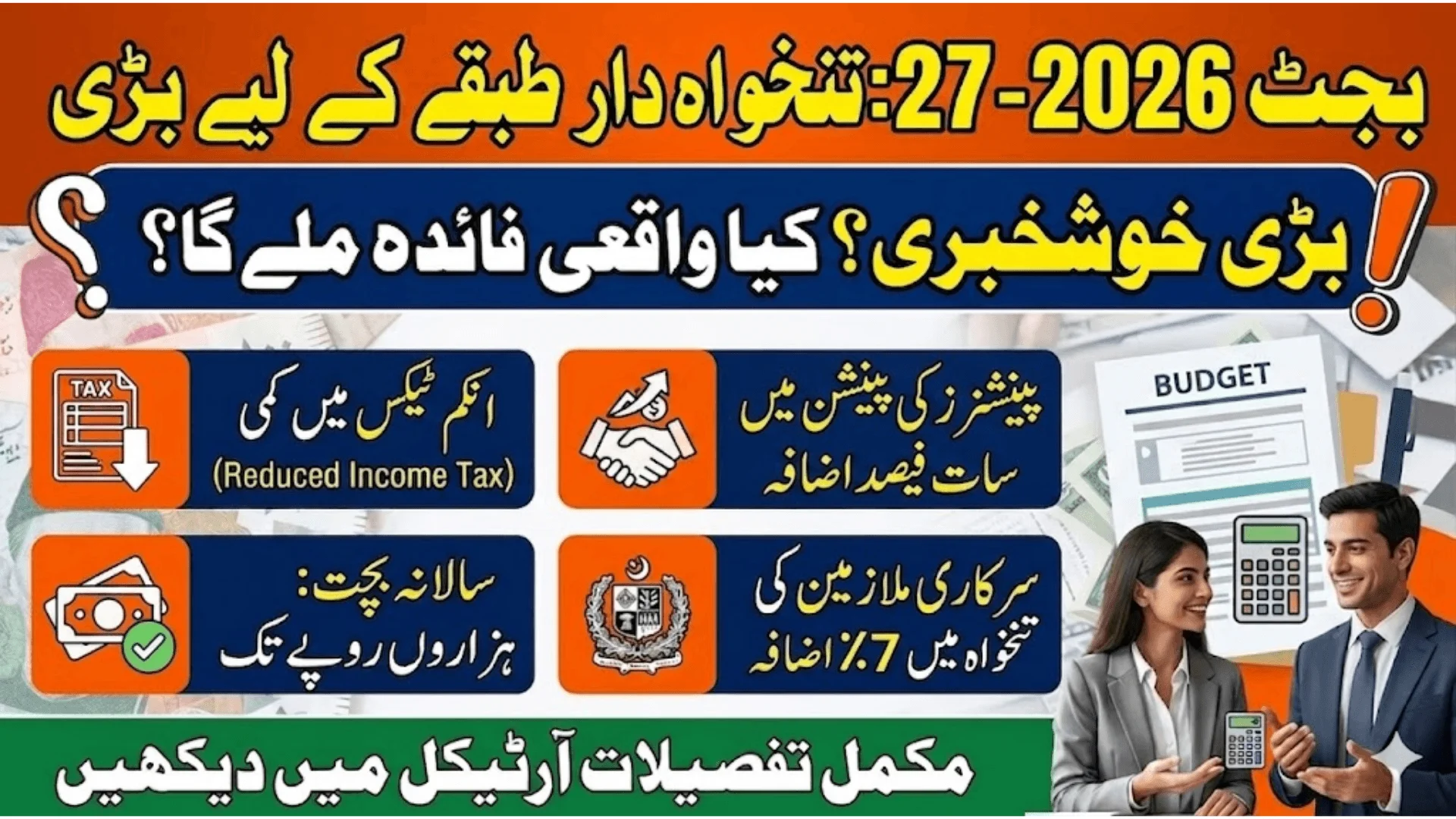
Pakistan Federal Budget 2026-27
Pakistan Federal Budget 2026-27: When the federal budget for fiscal year 2026–27 was placed before the National Assembly, one message rang louder than all others. The working population of Pakistan whether drawing a government paycheck or employed in the private sector would finally see meaningful reductions in their tax burden. The Finance Minister acknowledged openly that salaried workers have carried a disproportionate share of the tax load, and this year’s proposals are a deliberate step toward making that load more bearable.
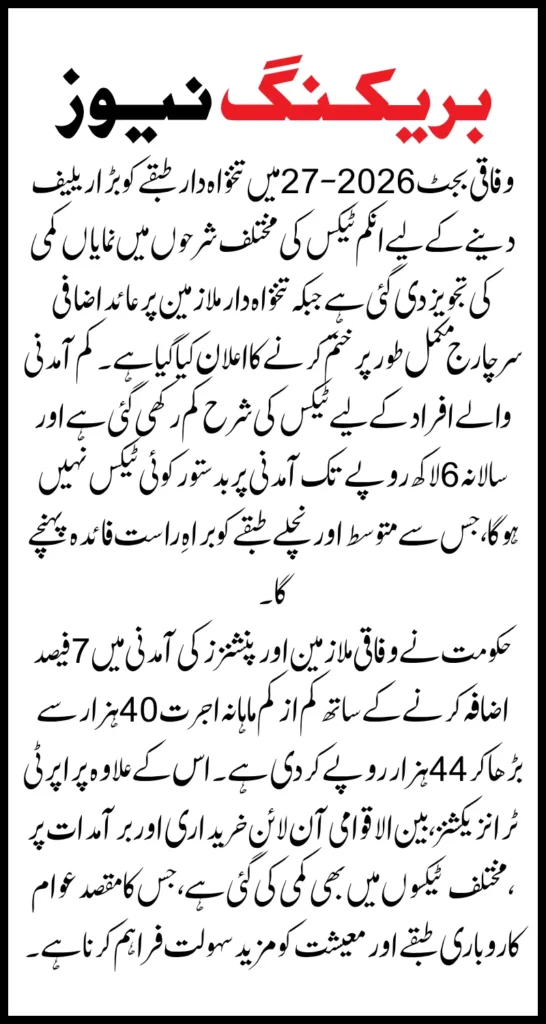
With revised income slabs, the removal of an additional levy on wages, and a series of wage-related announcements, the budget positions itself as one of the most worker-friendly financial plans in recent memory. The question now is whether these measures translate into real, felt relief at the household level.
Revised Income Tax Slabs A Closer Look at the Numbers
The heart of the tax relief package lies in the restructuring of income tax brackets for wage earners. Four specific earning ranges have been targeted for rate reductions, with new intermediate slabs introduced to prevent steep jumps between brackets. The proposed changes are significant in both scope and intent.
- Workers earning between Rs2.2 million and Rs3.2 million annually will now face a marginal rate of 20%, down from the previous 23%. Their tax liability is calculated as Rs116,000 plus 20% of income above Rs2.2 million.
- For those in the Rs3.2 million to Rs4.1 million range, the rate drops from 30% to 25%, with a base charge of Rs316,000 and 25% applied to amounts exceeding the lower threshold.
- Individuals earning between Rs4.1 million and Rs5.6 million will benefit from a reduction from 35% to 29%, with tax calculated as Rs541,000 plus 29% on the excess above Rs4.1 million.
- Those earning between Rs5.6 million and Rs7 million will see their rate lowered from 35% to 32%, with a base of Rs976,000 plus 32% on amounts beyond Rs5.6 million.
These are not token adjustments. For a professional earning Rs4.5 million annually, the savings under the new slab could amount to tens of thousands of rupees per year money that goes directly back into household spending and savings.
The End of the Surcharge A Victory for Salaried Workers
Perhaps no announcement drew more attention from the working class than the proposal to completely eliminate the surcharge that has been applied to salaried income. This additional tax had long been a source of frustration among employees who already felt squeezed between rising living costs and fixed salaries. The surcharge was reduced from 10% to 9% in the previous budget cycle, but complete removal had remained an outstanding demand.
The Finance Minister acknowledged this directly, framing the abolition as a response to sustained calls from working professionals. The elimination of this levy means that salaried individuals will no longer have a secondary tax biting into income that has already been taxed through the standard rate a structural improvement, not just a cosmetic one.
Also Read: BISP Document Verification June 2026 Installment Verify Your Documents
Lower-Income Earners Key Thresholds and Rates
The budget also addresses individuals at the lower end of the income spectrum:
- Annual income up to Rs600,000 (Rs50,000 per month): No income tax applicable this threshold remains protected.
- Monthly income between Rs50,000 and Rs100,000: A rate of just 1% is proposed, keeping the burden minimal for this bracket.
- Annual income above Rs1.2 million and up to Rs2.2 million: A rate of 11% is proposed on this band of earnings.
These provisions ensure that lower-middle-income earners are not disproportionately affected by the tax framework, and that relief is felt across wage levels not only at the higher end of the salary scale.
Also Read: BISP 8171 Payment Update 2026 Check CNIC Status And New 14500 Installment
Quick Reference: FY2026–27 Budget Highlights at a Glance
| Measure | Detail |
| Surcharge on salaried class | Proposed to be fully abolished |
| Tax rate: Rs2.2M–Rs3.2M | Reduced from 23% to 20% |
| Tax rate: Rs3.2M–Rs4.1M | Reduced from 30% to 25% |
| Tax rate: Rs4.1M–Rs5.6M | Reduced from 35% to 29% |
| Tax rate: Rs5.6M–Rs7M | Reduced from 35% to 32% |
| Tax on income Rs50K–Rs100K/month | 1% |
| Tax on Rs1.2M–Rs2.2M annually | 11% |
| Government salary increase | 7% raise announced |
| Pension increase | 7% increase for retirees |
| Minimum monthly wage | Raised from Rs40,000 to Rs44,000 (10%) |
| Withholding tax on property purchase (filers) | Reduced by 1% |
| Withholding tax on property sale (filers) | Reduced by 2.75% |
| Tax on international online shopping | Reduced from 5% to 0% |
| Advance income tax on exports | Reduced from 2% to 1.25% |
| Concessions on electric vehicles | Maintained for motorcycles, rickshaws, cars, buses |
Also Read: 8171 Web Portal CNIC Check 2026 See Your BISP Eligibility And Payment
Wages, Pensions, and the Minimum Salary Floor
Tax restructuring alone does not capture the full picture of worker-related measures in this budget. The Finance Minister also announced a 7% across-the-board increase in the salaries of all federal government employees a direct acknowledgment that inflation has eroded real purchasing power over recent years. Retired civil servants will receive the same percentage increment in their monthly pensions, providing some protection against the rising cost of living for those on fixed post-retirement incomes.
Key wage announcements at a glance:
- 7% salary hike for all federal government employees
- 7% pension increase for retired federal employees
- Minimum wage raised to Rs44,000 per month, up from Rs40,000 a 10% increase
The minimum wage revision is particularly significant for the informal and lower-wage segments of the workforce, many of whom operate in sectors where compliance with floor wages is closely watched. Moving the baseline from Rs40,000 to Rs44,000 puts more spending power in the hands of those least equipped to absorb inflation.
Also Read: BISP 8171 Dynamic Survey Restart Know New Payment Method
Transaction and Trade Tax Reductions
Beyond direct income relief, the budget includes a number of adjustments aimed at reducing the cost of common financial transactions:
- The withholding tax on property transactions for registered filers has been reduced buyers will pay 1% less, while sellers benefit from a 2.75% reduction. This is expected to stimulate activity in the real estate market and reduce the penalty on documented property deals.
- Cross-border online purchases will no longer attract a 5% withholding tax, bringing that rate to zero. In an increasingly digital economy, this move acknowledges how Pakistani consumers engage with international platforms and removes a friction point from everyday commerce.
- Advance income tax on exports has been brought down from 2% to 1.25%, a measure intended to improve cash flow for exporters and keep Pakistani goods price-competitive in international markets.
- Concessionary treatment for electric vehicles including motorcycles, three-wheelers, cars, and buses will continue, signaling the government’s intent to sustain the momentum of the EV transition without interruption.
Also Read: Benazir Kafalat 14500 June 2026 Eligibility Criteria Know Who Is Eligible
What This Means Going Forward
The budget proposals represent a coherent effort to shift some of the tax burden off the documented, salaried workforce. Critics will rightly note that these changes must be accompanied by broader structural reforms particularly widening the tax net to include sectors that remain largely undocumented. Relief for salaried workers is meaningful, but sustainable fiscal health requires more taxpayers, not just lighter rates on existing ones. Still, for the millions of Pakistanis receiving a monthly salary, this budget offers something concrete: lower deductions, no surcharge, better wage floors, and a government that at least in its stated priorities is paying attention to the pressures facing working households.
Also Read: How To Verify BISP 8171 Payment Status Online In 2026
Conclusion
The federal budget for fiscal year 2026–27 arrives at a moment when Pakistani households are acutely aware of the distance between their income and their expenses. Against that backdrop, the government’s decision to restructure income tax slabs, abolish the salaried surcharge, raise wages and pensions, lift the minimum wage floor, and ease transaction-related taxes represents a genuine and multi-layered effort to provide relief where it is most needed. These are not empty gestures the numbers are specific, the slab changes are substantive, and the removal of the surcharge addresses a grievance that the working class has voiced for years.
Also Read: BISP Rs. 14500 Payment Blocked? Get Your SIM Before June 15 Complete Detail