

Budget 2026-27 Highlights Government Unveils Economic Growth Plan
Budget 2026-27 Highlights: The Federal Budget 2026-27 sets out a comprehensive and ambitious roadmap for Pakistan’s economic future, placing strong emphasis on sustainable growth, fiscal responsibility, tax reforms, public welfare, and digital transformation. Through this budget, the government aims to create a more resilient economy capable of withstanding both domestic and international challenges while promoting long-term prosperity. Key measures have been introduced to provide relief to salaried individuals, improve social protection programs, and encourage business activity and private investment. The budget also focuses on strengthening critical sectors such as information technology, energy, agriculture, and infrastructure to support economic expansion.
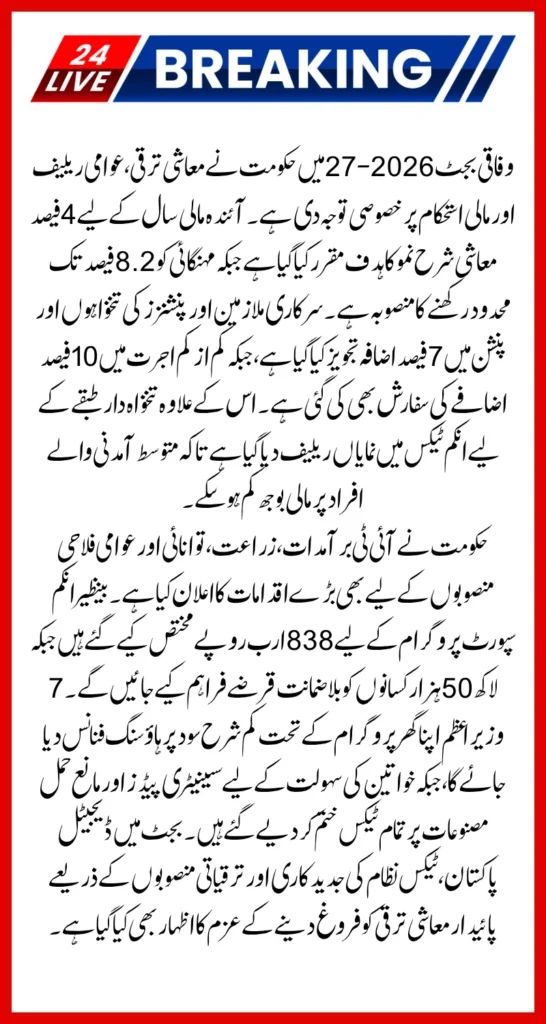
In addition, efforts to modernize tax administration and improve revenue collection are expected to enhance transparency and efficiency. By balancing development spending with fiscal discipline, the government seeks to maintain economic stability, boost investor confidence, generate employment opportunities, and improve the overall standard of living for citizens across the country.
Also Read: Pakistan Federal Budget 2026-27 Announces Big Financial Relief Through Tax Reductions
Economic Outlook and Recent Performance
For the fiscal year 2026-27, the government has set an economic growth target of 4 percent. Average inflation is expected to remain at 8.2 percent, while the fiscal deficit is projected at 3.6 percent of GDP.
Reviewing the performance of the previous year, the Finance Minister highlighted that the economy maintained momentum despite challenges such as devastating floods and regional geopolitical tensions. Economic growth reached 3.7 percent, with large-scale manufacturing expanding by 4.1 percent and the services sector recording an impressive 6.1 percent growth rate.
Pakistan’s per capita income increased from $1,751 to $1,901, while remittances are expected to reach $38 billion. Foreign exchange reserves have climbed to $17 billion, and inflation has declined significantly from 22 percent to 11.5 percent, reflecting improving macroeconomic conditions.
Key Budgetary Allocations
The budget outlines major revenue and expenditure targets to support government operations and development priorities.
Federal non-tax revenue has been projected at Rs 5,336 billion, while the federal government’s net income is estimated at Rs 11,751 billion. Total expenditures are expected to reach Rs 18,771 billion, including Rs 17,495 billion in current expenditures.
National defense has been allocated Rs 3,000 billion, while Rs 3,675 billion has been earmarked for the Public Sector Development Programme (PSDP). The Benazir Income Support Programme (BISP) will receive Rs 838 billion, representing a 17 percent increase compared to the previous year.
Under the National Finance Commission (NFC) Award, provinces will receive Rs 15,264 billion to support their development and administrative needs.
Salary and Pension Relief
Recognizing the impact of inflation on households, the government has announced a 7 percent increase in salaries for government employees. Pensioners will also receive a 7 percent increase in pension benefits.
In addition, a proposal has been made to raise the minimum wage by 10 percent, providing further support to low-income workers across the country.
Major Tax Relief for Salaried Individuals
One of the most significant features of the budget is the reduction of the tax burden on salaried taxpayers.
The government has proposed four revised income tax slabs designed to provide relief to middle-income earners. Tax rates for several income categories have been adjusted downward, reducing the burden on individuals who have historically contributed a substantial share of direct taxes.
The budget also proposes a reduction in the Super Tax for individuals earning more than Rs 150 million annually, lowering the rate from 10 percent to 8 percent.
These measures are intended to increase disposable income, encourage compliance, and create a more balanced tax structure.
Also Read: BISP Document Verification June 2026 Installment Verify Your Documents
Accelerating Digital Pakistan
The government highlighted the rapid growth of Pakistan’s information technology sector. IT exports are expected to reach $4.5 billion, reflecting the increasing contribution of technology to the national economy.
To support exporters, a 0.25 percent withholding tax will apply to IT exporters, while the Final Tax Regime (FTR) has been extended until June 2029. The expansion of 5G services has also begun, with deployment already underway in five major cities.
These initiatives are expected to strengthen Pakistan’s digital economy and enhance global competitiveness.
Energy Sector Reforms and Debt Management
Significant progress has been reported in the energy sector. The Competitive Trading Bilateral Contract Market (CTBCM) became operational in January 2026, marking an important step toward greater market efficiency.
The government also reported achieving net-zero accumulation of circular debt and repaying Rs 1,225 billion in liabilities. Furthermore, savings of $1.2 billion were achieved through LNG contract arrangements.
Pakistan’s public debt position has improved as well, with the debt-to-GDP ratio declining from 75 percent to 68.5 percent.
Also Read: BISP 8171 Payment Update 2026 Check CNIC Status And New 14500 Installment
Public Welfare and Development Initiatives
The budget introduces several new schemes aimed at supporting citizens and stimulating economic activity.
Under the “Zarkhaizi” initiative, 750,000 farmers will receive collateral-free loans totaling Rs 300 billion. The Prime Minister’s Apna Ghar Programme will offer mortgage financing at a subsidized 5 percent markup rate, helping families achieve homeownership.
The PAVE scheme will provide subsidized financing for electric vehicle purchases, while the Prime Minister’s Fan Replacement Programme will encourage households to replace outdated fans with energy-efficient models.
Additionally, the Agri Storage Financing Facility has been launched with an allocation of Rs 7.1 billion to strengthen agricultural storage infrastructure.
Privatization and Corporate Sector Developments
The government announced the sale of Pakistan International Airlines (PIA) for a total value of Rs 185 billion.
Meanwhile, the corporate sector showed strong performance, with corporate profits reaching 22 percent in March 2026. The Pakistan Stock Exchange also welcomed 173,000 new investors, highlighting growing confidence in capital markets.
Pakistan further diversified its financing options through the issuance of a $75 million Panda Bond.
Also Read: 8171 Web Portal CNIC Check 2026 See Your BISP Eligibility And Payment
Measures for Women’s Health
In a move aimed at improving access to essential healthcare products, the government has abolished taxes on sanitary pads and related items.
Taxes on contraceptives have also been completely removed, making reproductive healthcare products more affordable and accessible.
Modernizing the Tax Administration
The Federal Board of Revenue (FBR) is introducing a new operating model designed to enhance transparency and efficiency.
A National Faceless Centre will be established to eliminate direct interaction between taxpayers and tax officials. The government will also introduce an Algorithmic Settlement Mechanism and a Central Data Hub to improve tax administration and compliance.
For small retailers, a Fixed Tax System is being introduced, allowing businesses to fulfill tax obligations through a simplified annual payment starting from Rs 25,000.
Also Read: BISP 8171 Dynamic Survey Restart Know New Payment Method
Support for Special Regions
The budget also includes dedicated allocations for various regions of the country.
Azad Jammu and Kashmir will receive Rs 45 billion, Gilgit-Baltistan has been allocated Rs 44 billion, and Rs 56 billion has been earmarked for the merged districts of Khyber Pakhtunkhwa.
Conclusion
The Federal Budget 2026-27 seeks to balance economic growth, fiscal responsibility, and public welfare. Through tax relief for salaried workers, salary and pension increases, support for farmers and homeowners, digital economy initiatives, and reforms in tax administration, the government aims to strengthen economic confidence and create opportunities for sustainable development. Whether these targets are achieved will depend on effective implementation, but the budget clearly signals a commitment to growth, modernization, and citizen-focused reforms.
Also Read: Benazir Kafalat 14500 June 2026 Eligibility Criteria Know Who Is Eligible