
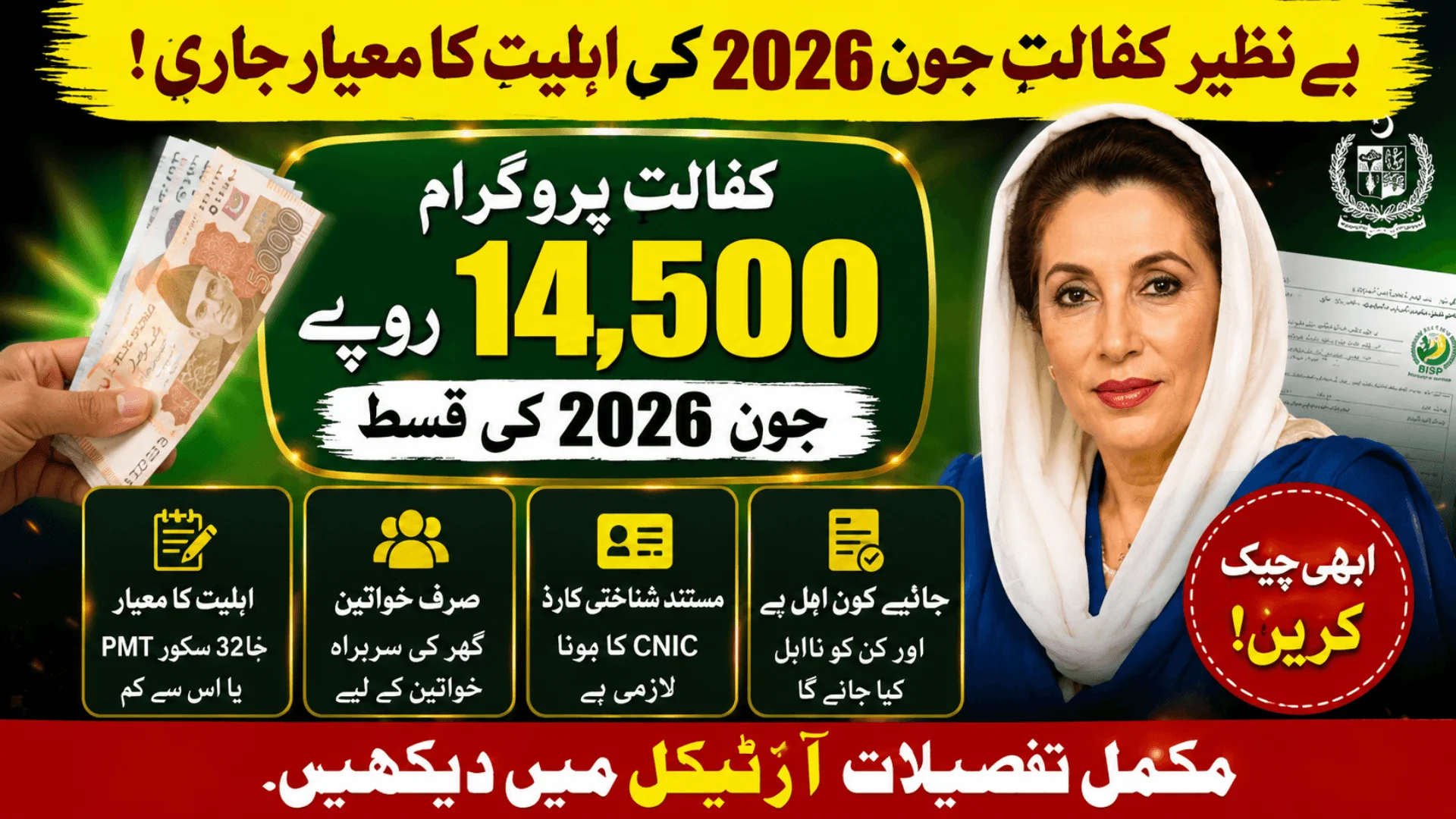
Benazir Kafalat 14500 June 2026 Eligibility Criteria
Benazir Kafalat 14500: Those families who are registered in Benazir Kafalat are waiting for June 2026 payment confirmation. This time, the government has set new eligibility conditions that a large number of previous recipients do not even know about. If you assume your name is still on the approved list without checking, you could miss out entirely. The Benazir Income Support Program has updated its verification process for the June 2026 disbursement cycle.
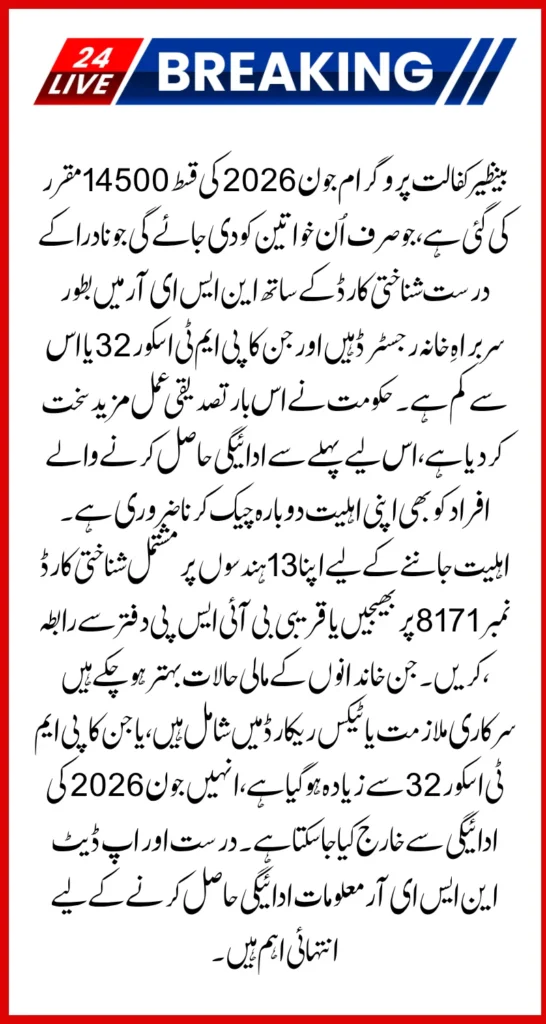
Beneficiaries who were receiving regular payments may find their status changed due to fresh NSER data, PMT score recalculations, or income reassessments conducted by district-level teams. The Rs. 14,500 quarterly payment is not automatic this time. Here is everything you need to know about who qualifies, what disqualifies, and how to confirm your eligibility before the payment window closes.
Also Read: BISP 8171 Payment Update 2026 Check CNIC Status And New 14500 Installment
Quick Answer Who Is Eligible for Benazir Kafalat 14500 in June 2026?
Women from low-income households registered in the NSER database with a PMT score of 32 or below are eligible for the Rs. 14,500 Benazir Kafalat June 2026 payment. The applicant must be the female head of household, hold a valid CNIC, and must not be employed in any government job or paying income tax.
Benazir Kafalat June 2026 Payment Overview
| Detail | Information |
| Program Name | Benazir Kafalat Program (BISP) |
| Payment Amount | Rs. 14,500 per quarter |
| Disbursement Cycle | June 2026 (Q2 2026) |
| Eligible PMT Score | 32 or below |
| Target Beneficiaries | Female heads of low-income households |
| Payment Method | HBL, UBL, Bank Alfalah (Kafalat Card) |
| Administered By | Benazir Income Support Programme (BISP) |
Also Read: Benazir Kafaalat Program 2026 Payment 14500 Check Online And Withdrawal
Confirmed Eligibility Conditions for June 2026 Payment
BISP has outlined specific qualifying conditions for the upcoming disbursement. These criteria apply regardless of whether you were a previous beneficiary or are applying for the first time. The National Socio-Economic Registry forms the backbone of the verification process, and your household data in the NSER system determines whether you pass or fail.
Women who are registered heads of households and have a Proxy Means Test score at or below 32 are the primary target group. The PMT score is calculated using household data including income sources, number of dependents, assets, housing conditions, and access to utilities. Families with accurate and recently updated data in the NSER system have a stronger chance of qualifying. Eligibility Conditions are given as:
- Must be a Pakistani female citizen with a valid CNIC
- Household PMT score of 32 or below in the NSER system
- Must be the registered female head of household
- Not a government employee and not a taxpayer
- No household member should hold a government job
- Family must not own more than 3 acres of agricultural land
- No household vehicle registered under family members
- Household must not have a registered business or commercial property
Who Will Be Removed from the June 2026 Beneficiary List
BISP conducts periodic reviews and the June 2026 cycle is one of the most thorough verification rounds in recent years. Families whose financial conditions have visibly improved, or whose data does not match field verification findings, will have their names removed from the active list. This is part of the government’s effort to direct funds to those who genuinely need them.
If any household member has recently taken a salaried job, purchased property, or was detected as a taxpayer through FBR records, the beneficiary status gets cancelled automatically. BISP works with the National Database and Registration Authority as well as the Federal Board of Revenue to cross-check data. Families living in urban areas with certain visible assets may also face reassessment. Common Reasons for Disqualification are:
- PMT score updated above 32 after fresh NSER survey
- Household member found registered in FBR taxpayer database
- A family member holds a government or semi-government job
- CNIC expired or not renewed with NADRA
- Death of registered beneficiary without family transfer request
- Duplicate registrations detected across districts
- Household owns agricultural land above the allowed limit
Also Read: 8171 Tracking Portal Update June 2026 Verify BISP Payment Status With CNIC
How to Check Your Eligibility Status for Benazir Kafalat 14500
BISP has provided multiple ways for beneficiaries to verify their payment status before visiting a designated payment center. The easiest and fastest method is sending your 13-digit CNIC number as an SMS to 8171. The system returns an automated reply showing whether your account is active, suspended, or pending for review.
For those who want more detail, the official BISP website at bisp.gov.pk has a beneficiary portal where you can log in using your CNIC and check your complete payment history, current status, and upcoming disbursement date. District BISP offices in cities like Lahore, Karachi, Peshawar, Quetta, and Multan also have walk-in facilitation desks where staff can assist with eligibility queries.
Step-by-Step Status Check Method
- Open your mobile messages and compose a new SMS
- Type your 13-digit CNIC number without dashes
- Send the SMS to 8171
- Wait for the automated reply confirming your status
- If status is unclear, visit the nearest BISP Tehsil Office with original CNIC
NSER Registration and Its Role in June 2026 Disbursement
The National Socio-Economic Registry is the central database that BISP uses to identify and rank deserving families. If your household is not registered in the NSER, you are not eligible for any BISP payment regardless of how low your income is. New registrations are accepted at BISP offices across all four provinces as well as Azad Kashmir and Gilgit-Baltistan.
For the June 2026 cycle, families who completed their NSER survey between late 2024 and early 2025 will have their data considered for the first time. Those who updated their household details after a major life change such as a death, marriage, or relocation will also see their data refreshed in the system. Accurate information is critical because even small discrepancies can result in payment holds.
Key Points About NSER Registration for Eligibility
- New registration requires your original CNIC and a family tree document
- NSER surveys are conducted by BISP field workers at your home address
- Incorrect or outdated information leads to wrong PMT scores
- You can request a data correction at your district BISP office
- Tehsil-level offices accept new NSER applications on working days
Also Read: BISP 8171 Double Payment Officially Announced For Eligible Families
Payment Collection Process and Bank Partners for June 2026
Once eligibility is confirmed, beneficiaries collect their Rs. 14,500 through designated banking channels. BISP has partnered with HBL, UBL, and Bank Alfalah for Kafalat card payments. Recipients with active Kafalat debit cards can withdraw funds from any ATM of these partner banks without visiting a branch.
For those without cards, mobile money options through Jazz Cash and EasyPaisa are also being expanded for the June 2026 cycle in selected districts. BISP sends SMS notifications to registered numbers when the payment is released and available for withdrawal. Beneficiaries are advised not to share their CNIC details or card PINs with any third party claiming to assist with payments, as fraud cases have increased in recent disbursement rounds.
Also Read: Pakistan’s Budget 2026-27 How Pakistan Plans To Regulate And Tax Digital Assets
What Changed in Benazir Kafalat 14500 Criteria Compared to Last Quarter
The June 2026 eligibility review is stricter than the December 2025 and March 2026 cycles. BISP has integrated new data from the Pakistan Bureau of Statistics household surveys and cross-referenced this with NADRA records to flag families whose socioeconomic conditions have changed. This round also includes a fresh look at urban beneficiaries in major cities where income levels have shifted.
One of the most significant changes is the tightening of the vehicle ownership rule. Previously, households with a motorcycle were still considered eligible in some cases. Under the June 2026 update, any household with a registered four-wheel vehicle, regardless of age or value, will face automatic disqualification during the data audit. BISP also introduced a new appeals mechanism for families who believe their disqualification was incorrect.
Also Read: Punjab Budget 2026 Expected To Boost Agriculture, Health And Education
Frequently Asked Questions About Benazir Kafalat June 2026
What is the exact amount for Benazir Kafalat June 2026 payment?
The June 2026 Benazir Kafalat payment is Rs. 14,500, paid quarterly to eligible beneficiaries.
Can a widow who is not head of household receive the payment?
No, a widow must be registered as the female head of household in the NSER database to receive Kafalat payments.
How long does it take after NSER registration to receive the first payment?
New applicants usually receive their first payment within 6–9 months after successful NSER registration and verification.
Can my daughter receive the Benazir Kafalat payment if she lives separately?
Yes, if she has a separate household, her own CNIC, and an eligible NSER registration.
What should I do if my payment was stopped without any notification?
Check your status through 8171 and visit the nearest BISP office with your original CNIC for assistance.
Is there any age limit for Benazir Kafalat beneficiaries in 2026?
There is no upper age limit; any eligible adult woman with a valid CNIC can qualify.
Can a woman receiving salary from a private company still qualify?
Yes, but eligibility depends on her household’s PMT score and overall income level.
Final Thoughts
The Benazir Kafalat 14500 June 2026 payment is a lifeline for millions of low-income families across Pakistan, but the updated eligibility conditions mean that not everyone who received payments before will continue to do so. Families should check their NSER status, verify their CNIC is active with NADRA, and confirm their PMT score has not crossed the 32 threshold. Women who believe they qualify but are not yet registered should visit their nearest BISP office and begin the enrollment process without delay.
The government is working to ensure funds reach those with the greatest need, and the June 2026 cycle reflects a more data-driven approach to disbursement. If your eligibility is unclear or you have recently faced a household change, the 8171 helpline and district offices remain the most reliable sources of current information. Keeping your household data accurate in the NSER system is the single most important step toward securing your payment.
Also Read: 8171 Wazifa Check Online By CNIC And Track Your BISP Eligibility Status Easily