

MacBooks And iPads May Soon Cost Much More In Pakistan
Apple just made it official. On June 25, 2026, the company announced price increases across its entire Mac and iPad lineup, and the reason behind the move is something most buyers never saw coming. It has nothing to do with new features or a product upgrade. The culprit is a global memory chip shortage so severe that Apple CEO Tim Cook described it as a “hundred-year flood” in an interview with The Wall Street Journal last week. For Pakistani buyers who were already paying some of the highest prices in the region for Apple products after factoring in FBR import duties and PTA taxes, this global price hike comes at the worst possible time.
Lahore’s Hafeez Centre and Karachi’s saddar markets are already buzzing with nervous retailers wondering just how much the landed cost of a MacBook Air or iPad Pro is going to climb before the dust settles. The question every Apple fan in Pakistan is asking right now is simple: how much more will this hurt the wallet? The answer is not comfortable.
Also Read: BISP 14500 Payment 2026 Confirmed 8171 Portal, Account Restoration & Taleemi Wazaif Details
Quick Answer
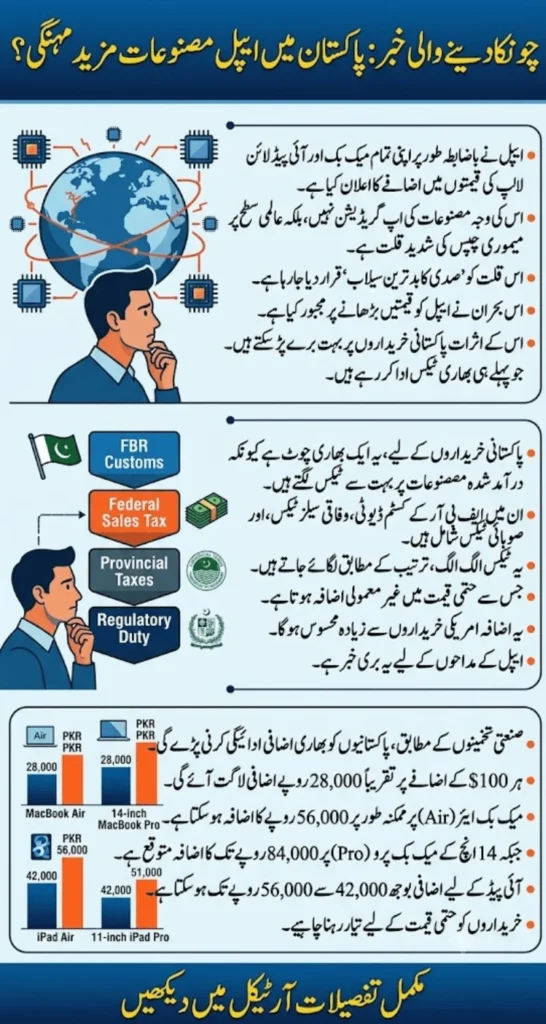
Apple officially raised prices on MacBook Neo, MacBook Air, MacBook Pro, iPad Air, and iPad Pro on June 25, 2026. The increases range from $100 to $300 per device globally. In Pakistan, where Apple products are imported and taxed heavily by FBR, industry estimates suggest each $100 USD price rise can add roughly Rs. 28,000 to the final retail cost after duties and margins are applied.
Key Facts at a Glance
| Detail | Information |
| Announcement Date | June 25, 2026 |
| Products Affected | MacBook Neo, MacBook Air, MacBook Pro, iPad Air, iPad Pro |
| MacBook Neo New Price (US) | $699 (up from $599) |
| MacBook Air New Price (US) | $1,299 (up from $1,099) |
| MacBook Pro 14-inch New Price (US) | $1,999 (up from $1,699) |
| iPad Pro 11-inch New Price (US) | $1,199 (up from $999) |
| iPad Air New Price (US) | $749 (up from $599) |
| iPhone Price Change | None (iPhones were not affected) |
| Reason | AI-driven DRAM and NAND flash memory chip shortage |
| Pakistan Impact (per $100 USD hike) | ~Rs. 28,000 additional cost (before margins) |
Also Read: CM Punjab SEHR Program 2026 Eligibility, Training Courses, Benefits & How To Apply
Why Apple Suddenly Raised Prices Worldwide
This is not a routine annual adjustment. Apple raised iPad and MacBook prices on Thursday, saying it could no longer shield customers from soaring memory and storage chip costs driven by the AI industry’s datacenter buildout.
Apple said in a statement: “The rapid expansion of AI data centers has created an extraordinary surge in demand for memory and storage. We have never seen a component price increase this much, this quickly.” The company added that it had been absorbing rising costs for months before reaching this point.
The root cause is a phenomenon industry analysts have started calling “RAMageddon.” Prices of dynamic random access memory (DRAM), used in virtually all modern tech gadgets, rose as much as 98% in the first quarter of 2026 and are set to jump by another 58% to 63% in the current quarter, according to industry tracker TrendForce. This surge has been driven by AI data centers snapping up enormous volumes of high-performance memory chips, leaving little supply for consumer electronics manufacturers.
In 2026, data centers are expected to consume as much as 70% of total memory production. In practical terms, for every ten chips coming off a production line, seven are going straight to server farms running AI workloads. The remaining three are shared among Apple, Samsung, Dell, and every other consumer electronics maker on the planet.
Exactly Which Apple Products Got More Expensive
The company is increasing prices of the MacBook Neo, MacBook Pro, MacBook Air, iPad Air, and iPad Pro. The starting price of the MacBook Neo is rising to $699 from $599, while the MacBook Air is increasing to $1,299 from $1,099. The entry-level 14-inch MacBook Pro is moving to $1,999 from $1,699, while the 11-inch iPad Pro is increasing to $1,199 from $999. The iPad Air is now priced at $749, up from $599.
These are not minor adjustments. The MacBook Air alone has gone up by $200, and the iPad Air has jumped by $150. The price hikes are global, and the company did not raise iPhone prices on Thursday. That said, Apple has already signalled that iPhone prices may also see upward revisions later in 2026, particularly for the high-storage variants launching in September.
Here is a quick summary of the new US prices vs old prices:
- MacBook Neo: $599 → $699 (up $100)
- MacBook Air: $1,099 → $1,299 (up $200)
- MacBook Pro 14-inch: $1,699 → $1,999 (up $300)
- iPad Pro 11-inch: $999 → $1,199 (up $200)
- iPad Air: $599 → $749 (up $150)
Also Read: JazzWorld Launches International Roaming Deal For Iraq And Iran Ziyarat Travelers
What This Means for MacBook and iPad Buyers in Pakistan
Pakistan has no domestic assembly for Apple products. Every MacBook and iPad sold here arrives as a fully imported unit, which means the full burden of Pakistan’s layered import taxation system lands on top of the already higher global retail price.
A single laptop in Pakistan incurs multiple levies: 1% customs duty on CIF value, 17% sales tax (federal), plus provincial taxes, and a 3 to 5% regulatory duty for non-essential electronics. These are applied sequentially, not additively, amplifying the final retail markup. When you stack those charges on top of a $200 increase in base price, the consumer-end impact in Pakistan is significantly larger than what buyers in the US will experience.
Industry estimates suggest that every $100 increase in Apple’s global retail price could translate into roughly Rs. 28,000 in additional cost, while a $150 increase could add around Rs. 42,000, before PTA taxes, import duties, retailer margins, and exchange-rate fluctuations are factored in.
Using those estimates, here is what Pakistani buyers could expect to pay extra:
- MacBook Neo (up $100): approximately Rs. 28,000 more
- MacBook Air (up $200): approximately Rs. 56,000 more
- MacBook Pro 14-inch (up $300): approximately Rs. 84,000 more
- iPad Pro 11-inch (up $200): approximately Rs. 56,000 more
- iPad Air (up $150): approximately Rs. 42,000 more
As of early 2026, high-end Apple MacBook Pro models in Pakistan were already exceeding Rs. 2.3 million. A Rs. 84,000 addition on top of that pushes the MacBook Pro even further out of reach for the average Pakistani professional or student.
The AI Boom That Pakistani Consumers Are Now Paying For
This entire crisis connects directly to the explosion of artificial intelligence infrastructure globally. Memory chips, specifically DRAM and NAND flash, are essential components in virtually every Apple product. They determine how much RAM your MacBook has and how much storage your iPad offers. When supply tightens, prices climb, and manufacturers face a choice: eat the cost or share it with customers.
Memory and storage prices have quadrupled in the past three quarters, according to Counterpoint Research, as suppliers steer more production toward high-bandwidth memory used in AI accelerators. Companies like Micron have effectively locked in long-term supply deals with AI chipmakers like Nvidia, prioritising those contracts over the consumer electronics supply chain that Apple, Dell, and others depend on.
Tim Cook had been warning about this for weeks. Cook publicly acknowledged the cost pressure and framed the price hikes as “unavoidable,” a notable admission given that Apple routinely posts gross margins north of 40%.
Also Read: BISP 8171 Online Wallet Registration 2026
Pakistan’s Apple Market Was Already Under Pressure
Even before this announcement, Apple device affordability in Pakistan was a genuine problem. The mobile and laptop market in Pakistan in 2026 reflects a combination of global supply pressure and local economic constraints. Consumers across Pakistan now face record-high prices for basic and premium devices, with entry-level laptops crossing PKR 99,000 and flagship smartphones exceeding PKR 400,000.
High inflation and fuel price hikes raise transportation and distribution costs across the supply chain. Interest rates set by the State Bank of Pakistan make it expensive for importers to finance inventory, which leads to higher retail pricing. The 18% federal sales tax on electronics has not been reduced. Dollar fluctuations continue to add unpredictability to pricing.
The current USD to PKR rate hovering near 280 means that even without any new Apple-initiated price increase, importers were already passing higher costs to buyers. The global price hike now adds a second layer of pressure that Pakistani retailers will almost certainly pass on in full.
Should You Buy Now or Wait?
This is the practical question. Given that the price increases are already live on Apple’s global store as of June 25, 2026, local Pakistani distributors and importers will begin adjusting their stock pricing within days to weeks depending on inventory levels.
Buyers who were on the fence about a MacBook Air or iPad Air should note:
- Current stock in Pakistani markets may still reflect old pricing for a short window
- Grey-market units sourced from Dubai may absorb part of the increase initially, but that gap closes fast
- Waiting for a price correction is unlikely, as memory chip supply conditions are not expected to improve in the short term
- The global chip supply may take time to stabilize as AI demand continues to dominate production priorities, meaning limited short-term relief for consumers
If you have been planning a MacBook purchase and the budget allows, buying from a local authorised dealer while old-priced stock remains is a more practical move than waiting.
Also Read: Non-PTA Mobile Registration From July 1 Users Can Pay PTA Tax In Installments
FAQ: Apple MacBook & iPad Price Hike in Pakistan 2026
Why did Apple raise MacBook and iPad prices in 2026?
Apple raised prices because a global shortage of DRAM and NAND flash memory chips, caused by massive AI data center demand, drove component costs to unprecedented levels that Apple could no longer absorb.
Which Apple products got a price increase on June 25, 2026?
MacBook Neo, MacBook Air, MacBook Pro (14-inch), iPad Air, and iPad Pro all received price increases. iPhone prices were not changed in this round.
How much will a MacBook Air cost more in Pakistan after this hike?
The MacBook Air went up by $200 globally. In Pakistan, after factoring in FBR duties and retail margins, the increase is estimated at approximately Rs. 56,000 or more.
Did iPhone prices increase too?
No. Apple specifically excluded iPhones from this price adjustment, though analysts expect iPhone pricing to be revised later in 2026 when new models launch.
Is it better to buy an Apple MacBook now or wait for prices to drop?
Given that the memory chip shortage is expected to persist throughout 2026, waiting for a price reversal is unlikely to be a productive strategy. Existing stock at older prices may still be available in Pakistan for a limited time.
Will Pakistan-sourced grey-market MacBooks be cheaper?
Grey-market units from Dubai may initially reflect the older pricing, but once those importers restock, the new global prices will apply to their purchases too.
What is “RAMageddon” and how does it affect Pakistanis?
RAMageddon is the term analysts use for the current DRAM price crisis. DRAM prices rose 98% in Q1 2026 alone. Since Pakistan imports 100% of its Apple devices, those higher component costs travel directly to Pakistani retail shelves.
What Happens Next
Apple’s price changes are live globally as of today, June 25, 2026. Pakistani distributors will need time to clear existing inventory before the new pricing fully filters into local markets. That window could be days or it could stretch into a few weeks depending on stock levels at places like iStore authorised resellers across Karachi, Lahore, and Islamabad.
John Ternus, who will take over as Apple CEO on September 1, 2026, will inherit the memory crisis. His approach to managing chip costs and whether Apple will pursue more aggressive long-term supply agreements could shape pricing well into 2027. For now, Pakistani Apple users are watching a situation that started in AI server farms halfway around the world land directly on their bank accounts.
Also Read: Ashura Holidays 2026 Officially Announced For 9th And 10th Muharram