

Pakistan’s Budget 2026-27
Pakistan’s Budget 2026-27: If you have been trading Bitcoin, Ethereum, or any other digital currency in Pakistan, the government now has its eye on your profits. For the first time in Pakistan’s financial history, the upcoming federal budget is expected to formally bring cryptocurrency gains under the income tax system and the rates being discussed are anything but light.
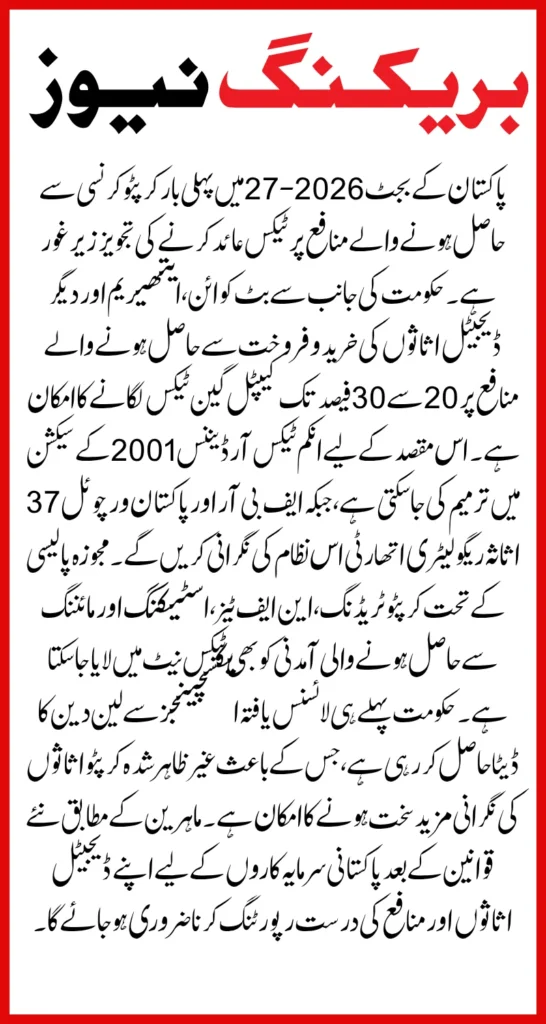
This is not a rumour or a proposal buried in a committee report. Consultations between Pakistan’s finance ministry and the International Monetary Fund have already concluded, and the legal groundwork is being laid right now. Whether you are a casual crypto holder or an active trader, what gets announced on budget day will directly affect your wallet.
Also Read: MPIP Punjab Gov PK Internship 2026 Online Application Process
Quick Answer
Pakistan’s Budget 2026-27 is expected to introduce capital gains tax (CGT) on cryptocurrency profits at a rate between 20% and 30%. The government plans to amend Section 37 of the Income Tax Ordinance, 2001, to include digital asset gains. All crypto sales, trades, and conversions would become taxable events for Pakistani residents.
Key Facts at a Glance
| Detail | Information |
| Budget Year | 2026-27 |
| Proposed CGT Rate | 20% to 30% |
| Legal Mechanism | Amendment to Section 37, Income Tax Ordinance 2001 |
| Regulatory Body | FBR (Federal Board of Revenue) |
| Valuation Method | FIFO (First-In, First-Out) |
| Pakistan Crypto Users | Approximately 9 million |
| IMF Involvement | Yes part of ongoing fiscal consultations |
| Oversight Authority | PVARA (Pakistan Virtual Assets Regulatory Authority) |
Also Read: BISP 8171 Wallet Account Is Now Ready Your Complete Guide For 2026
Why Is Pakistan Taxing Crypto Now?
Pakistan sits among the top countries globally for cryptocurrency adoption, with an estimated nine million active users. For years, this entire market operated without a single rupee of tax being collected on trading profits. The Federal Tax Ombudsman flagged the issue formally, noting that billions in transactions were taking place completely outside the documented economy.
The IMF, which has been working closely with Islamabad on Pakistan’s fiscal consolidation agenda, pushed for crypto capital gains to be brought into the tax net alongside reforms in real estate and listed securities. The government could not afford to leave such a large revenue source untouched any longer.
The Virtual Assets Act passed earlier in 2026 gave PVARA the authority to license exchanges and classify digital items including NFTs as virtual assets. That legal foundation made taxing the sector the logical next step.
What Exactly Will Be Taxed?
Trading Gains The Straightforward Part
Buying Bitcoin at one price and selling it higher is the simplest case. The government plans to treat this exactly like a stock market transaction gains realized on disposal would be taxable using the FIFO method, meaning the oldest coins you hold are treated as sold first.
Activities That Get Complicated
Beyond simple trading, the proposed framework also intends to address a wider range of crypto activities. The taxation of these involves layers of complexity since many do not involve conventional bank transfers at all:
- Mining income (treated as regular income, not capital gains)
- Staking rewards from proof-of-stake networks
- Yield farming returns from DeFi protocols
- Profits from NFT sales and resales
- Gains from ICO and IEO token participation
- Returns from decentralized lending and borrowing platforms
Also Read: 8171 Wazifa Check Online By CNIC And Track Your BISP Eligibility Status Easily
How Will the Tax Rate Work?
Holding Period Could Determine Your Rate
Policymakers are considering a tiered structure where the tax rate varies depending on how long you held the asset before selling. Assets held for shorter periods would attract higher rates to reduce speculative activity, while long-term holders may benefit from a lower rate.
This mirrors how capital gains on real estate and listed securities already work in Pakistan’s tax code a policy precedent that makes the approach politically easier to defend.
FIFO Valuation Explained Simply
Under FIFO, if you bought 1 BTC in January and another in March, and then sell 1 BTC in June, the tax calculation uses the January purchase price as your cost basis. This can result in higher taxable gains if prices have risen significantly since your first purchase.
The Offshore Holdings Problem
A Sensitive Issue With No Easy Answer
Many Pakistani investors opened accounts on international platforms years ago, when no domestic legal option existed. Some used foreign addresses or offshore exchanges to access markets that were not available locally. Now, with taxation arriving, these holdings sit in a grey zone.
Tax professionals warn that if the government does not offer a structured compliance window, investors with offshore assets face an impossible choice: declare and potentially face scrutiny over past non-compliance, or keep assets hidden and risk penalties if discovered later.
Key concerns around offshore holdings:
- FBR has started receiving transaction data from major exchanges
- Wallet addresses can be matched with exchange records
- Undeclared offshore accounts may attract separate foreign asset penalties
- A transitional amnesty window could be the only practical solution
Also Read: Government Increases BISP Assistance To Rs. 19500 Check Latest Details
What FBR Has Already Done
Pakistan did not arrive at this point overnight. The FBR blocked over 1,000 accounts in the first quarter of 2026 alone for missing documentation. Transaction reporting is already being collected from licensed exchanges through PVARA. The IRIS portal has been updated to include a Capital Gains category for digital assets.
The enforcement machinery is in place. The budget announcement will simply set the official rates and formalize the legal obligation.
Impact on Pakistani Crypto Investors
Who Feels the Most Pressure?
- Active day traders who realize frequent short-term gains
- Users holding significant crypto balances on offshore platforms
- Miners and stakers earning regular crypto income
- Businesses accepting crypto as payment
Who May Be Less Affected?
- Long-term holders who may qualify for reduced rates under tiered structures
- Investors whose annual profits fall below the taxable threshold
- Registered users of licensed domestic exchanges already in the FBR system
Also Read: 8171 CNIC Web Portal Tracking System Verify Your BISP Payment With CNIC
FAQ
Q: When will Pakistan’s crypto tax officially take effect?
It is expected to be announced as part of Budget 2026-27 and take legal effect once the Finance Bill is passed and signed into law.
Q: What is the proposed crypto tax rate in Pakistan?
The rate under discussion is between 20% and 30% on realized capital gains from cryptocurrency transactions.
Q: Does Pakistan consider cryptocurrency legal?
Yes cryptocurrency is legal to hold and trade in Pakistan under the Virtual Assets Act 2026, though it is not recognized as legal tender in place of the Pakistani Rupee.
Q: Will mining income be taxed differently from trading profits?
Yes mining and staking rewards are likely to be classified as regular income rather than capital gains, meaning they could be taxed at standard income tax slab rates.
Q: How will FBR know about my crypto trades?
FBR has been receiving transaction data from licensed exchanges since mid-2025 and can match wallet addresses with account records through PVARA-registered platforms.
Q: What is the FIFO method and why does it matter for crypto tax?
FIFO means your oldest purchased coins are treated as the first ones sold when calculating gains, which can increase your taxable profit if early purchases were made at lower prices.
Q: What happens if I do not report my crypto gains?
Non-compliance can result in financial penalties, interest charges, account restrictions, and potential tax audits by FBR.
Conclusion
Pakistan’s decision to tax cryptocurrency gains is not a surprise it has been building for years through IMF pressure, FBR data collection, and the passage of the Virtual Assets Act. What the Budget 2026-27 does is put a number on it and make the obligation legally binding. For the millions of Pakistanis who have been trading digital assets in an informal space, the window for operating without tax accountability is closing.
The bigger question going forward is whether the government pairs this tax with a transparent amnesty path for previously undeclared holdings because without one, a large portion of the market may simply remain underground rather than step into the light. Watch for the fine print in the Finance Bill, not just the headline rate.
Also Read: BISP 8171 Double Payment Officially Announced For Eligible Families