
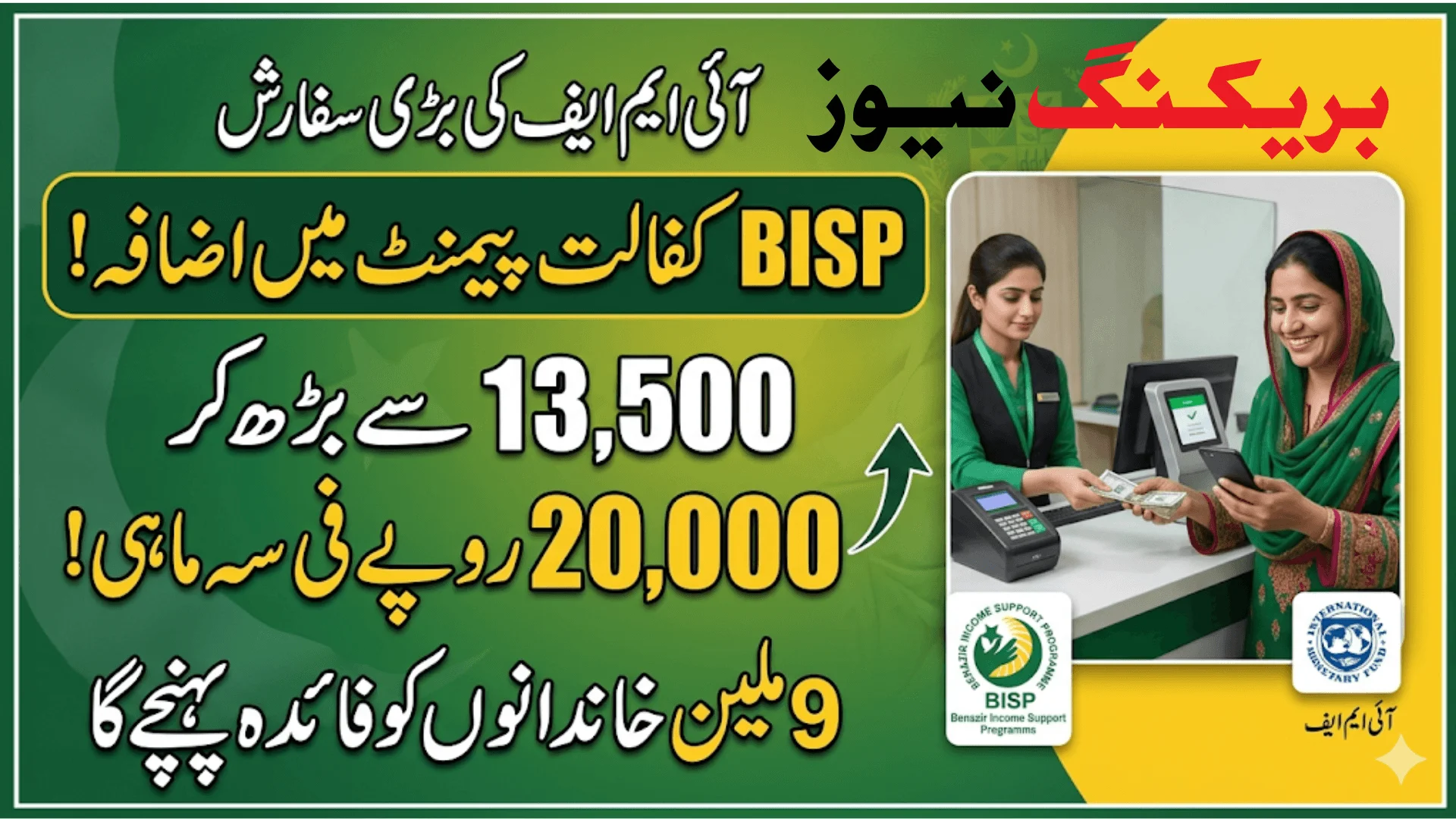
Increase In BISP Kafalat Payment To Rs. 20000
Increase In BISP Kafalat Payment: The International Monetary Fund has formally recommended that Pakistan raise its Benazir Income Support Program Kafalat cash transfer from Rs. 13,500 to Rs. 20,000 per quarter. This proposal, delivered as part of ongoing loan program discussions, signals a significant shift in how international financial institutions view social protection spending in developing economies. Rather than treating welfare disbursements as fiscal liabilities, the IMF now appears to position them as stabilising tools for low-income households bearing the brunt of aggressive economic reforms.
Pakistan’s Benazir Income Support Program currently serves over nine million registered beneficiaries across rural and urban areas. The suggested enhancement would mark the largest single increase in Kafalat stipends since the program was restructured under the PTI government, and it arrives at a time when inflation continues to erode household purchasing power among the country’s most economically vulnerable segments. The IMF recommendation is expected to feature prominently in budget deliberations for the upcoming fiscal year.
Also Read: Apna Khet Apna Rozgar 2026 Registration Form, Eligibility & How To Apply Online
BISP Quarterly Stipend Hike What the IMF Proposal Covers
The proposal to raise the Kafalat quarterly grant to Rs. 20,000 represents an increase of approximately 48 percent over the existing Rs. 13,500 payment. According to sources familiar with the IMF-Pakistan staff-level discussions, the recommendation is framed within a broader framework of expanding targeted social safety nets while the government pursues fiscal consolidation measures. The fund’s position reflects a growing global consensus that conditional cash transfer schemes must be indexed to inflation if they are to remain meaningful for recipient households.
Pakistani officials from the Ministry of Finance and the Poverty Alleviation and Social Safety Division have indicated that the federal budget for fiscal year 2025-26 is being designed with this enhanced allocation in mind. The government has also confirmed that any upward revision to Kafalat payments would be implemented in phases to manage fiscal pressures, while ensuring that existing beneficiary families receive the enhanced amount without delays in the payment cycle.
Key Figures Behind the Recommended Payment Revision
• Current quarterly Kafalat stipend stands at Rs. 13,500 per registered household
• IMF-recommended revised amount is Rs. 20,000 per quarter, a rise of around Rs. 6,500
• Over 9 million households are currently enrolled under the BISP Kafalat program
• Pakistan’s social protection budget would require a substantial increase to fund the enhanced disbursements
• The IMF recommendation is aligned with Pakistan’s ongoing Extended Fund Facility programme review conditions
Social Safety Net Expansion and IMF Conditionality in Pakistan
Pakistan’s relationship with the IMF has historically been defined by demands for fiscal austerity, subsidy removal, and tax base expansion. However, the fund’s latest stance on BISP reflects a modified approach in which the removal of untargeted energy and fuel subsidies is accompanied by a corresponding strengthening of direct cash assistance to low-income families. This shift is seen as essential for maintaining political and social stability while structural economic reforms are rolled out, particularly in the context of rising utility bills and food costs.
The Benazir Income Support Programme has long been regarded as one of South Asia’s more successful targeted assistance frameworks, with a biometric verification system and a national socioeconomic registry that helps reduce leakage. The IMF’s endorsement of a higher Kafalat payment effectively validates this architecture and suggests that increasing disbursement levels within an already well-structured programme carries lower fiduciary risk than launching new welfare channels. Civil society organisations and development economists have broadly welcomed the recommendation, though some caution that implementation capacity must keep pace with any increase in beneficiary payments.
Also Read: How To Get Your BISP Quarterly Payment Before June 15
Conditions and Criteria Linked to the Proposed BISP Payment Raise
• Enhanced payments are expected to remain targeted exclusively at National Socioeconomic Registry-verified poor households
• The IMF has linked expanded social transfers to the phased withdrawal of generalised energy subsidies to maintain fiscal neutrality
• Biometric attendance and verification protocols must remain intact to prevent duplication of beneficiary records
• The government is required to maintain transparency in disbursement data shared with the fund during quarterly programme reviews
• Female-headed households and persons with disabilities are to remain prioritised categories within the updated payment structure
Impact on Poor Households Purchasing Power and Poverty Reduction Outlook
For a family receiving Kafalat assistance, an increase from Rs. 13,500 to Rs. 20,000 each quarter translates into an additional Rs. 2,167 per month. While this figure may appear modest in absolute terms, it carries significant weight in rural districts where the average daily household expenditure among lower-income groups falls well below the national average. Independent assessments from the Pakistan Poverty Alleviation Fund suggest that even incremental increases in quarterly disbursements have historically correlated with reduced child malnutrition rates and higher school enrolment among girls in beneficiary families.
Economists tracking Pakistan’s inflation trajectory note that the consumer price index has risen sharply over the past two years, with food inflation disproportionately affecting low-income households. A higher Kafalat payment, if implemented in the upcoming budget cycle, would partially offset the real-income losses sustained by registered BISP families since the last stipend revision. Development partners including UNICEF and the World Bank have separately advocated for inflation-adjusted cash transfers as a core component of any sustainable poverty alleviation strategy in Pakistan.
Also Read: BISP Wallet Account Verification Know How To Verify Instantly
Expected Socioeconomic Benefits of Raising Quarterly Kafalat Grants
• Improved household food security among registered families in food-insecure districts of Sindh, Balochistan, and southern Punjab
• Reduced dropout rates at primary school level, particularly for girls whose education is often the first casualty of household financial stress
• Potential boost to local microeconomic activity as increased cash circulation supports small vendors and informal traders in rural markets
• Decreased reliance on informal moneylenders and predatory credit among economically marginalised families
• Better alignment between Pakistan’s social protection spending and regional benchmarks set by comparable South Asian economies
Government Response and Budget 2025-26 Implications for Welfare Spending
Federal officials have responded cautiously but positively to the IMF’s welfare payment recommendation. The Ministry of Finance has confirmed that social protection remains a protected category in the current budget framework, meaning that even as tax revenues are being renegotiated and expenditure ceilings are being reviewed, allocations for BISP are expected to remain insulated from across-the-board cuts. This represents a notable departure from earlier budget cycles in which welfare allocations were frequently reduced to meet deficit targets.
The Poverty Alleviation and Social Safety Division has been directed to prepare an implementation roadmap that outlines the logistics of transitioning to a higher per-household payment, including updating payment orders issued to partner banks and mobile money service providers. Pakistan’s network of Kafalat disbursement points includes both conventional bank branches and agent-based digital payment outlets, which collectively serve beneficiaries in areas with limited banking infrastructure. A smooth transition to the higher payment amount will require coordination across all these distribution channels well in advance of the first payment date under the revised structure.
Also Read: 8171 BISP Quarterly Payment Verification Check Online Status
What Comes Next BISP Kafalat Payment Timeline and Rollout Expectations
Pakistan’s federal budget for fiscal year 2025-26 is scheduled to be presented to the National Assembly in June. If the government formally accepts the IMF recommendation and includes the enhanced Kafalat allocation in the annual budget, the revised payment could become effective as early as the first quarter of the new fiscal year. However, policy analysts caution that administrative readiness, fund disbursement from international lenders, and parliamentary approval of the full budget are all prerequisites that must align before any beneficiary receives the increased amount.
Pakistan’s progress in implementing this recommendation will likely be reviewed during the next IMF programme review mission, where social protection expenditure adherence forms part of the structural benchmark assessment. For the millions of families enrolled in BISP, the outcome of these policy negotiations carries immediate and tangible consequences for their daily welfare. Whether the government delivers the recommended increase on schedule will serve as an important indicator of its commitment to protecting the most economically vulnerable Pakistanis during one of the country’s most challenging fiscal periods in recent history.
Conclusion
The IMF’s recommendation to raise the BISP Kafalat quarterly payment to Rs. 20,000 is more than a fiscal adjustment it is a recognition that sustainable economic reform cannot be built on the backs of the country’s most vulnerable citizens. For over nine million registered households, this proposed increase represents a meaningful improvement in their capacity to meet basic needs at a time when the cost of food, utilities, and essential services continues to climb. If implemented effectively, the enhanced stipend has the potential to reduce poverty indicators, improve child welfare outcomes, and inject modest but meaningful economic activity into underserved communities across Pakistan.
The path forward depends on political will, administrative efficiency, and fiscal coordination between the federal government and international lending partners. Pakistan has demonstrated, through years of BISP operation, that it possesses the institutional infrastructure to deliver targeted cash support at scale. What remains to be seen is whether the upcoming budget will translate the IMF’s recommendation into a concrete, timely commitment for the millions of families who depend on Kafalat assistance as their primary financial lifeline. The decisions made in the coming weeks will define the government’s legacy on social protection for the foreseeable future.
Also Read: 8171 Web Portal 2026 Check Your Rs. 14500 BISP Payment Status Online